
Guides
Chiang Mai Rainy Season Motorbike Safety: Riding in Wet Weather
Chiang Mai rainy season motorbike safety explained: how wet roads change grip and braking, which hazards matter most, when to stop and wait out a storm, and what to check before you ride.
14 min read
By Daniel Calleja, founder of The Chiang Mai Brief and Chiang Mai resident.
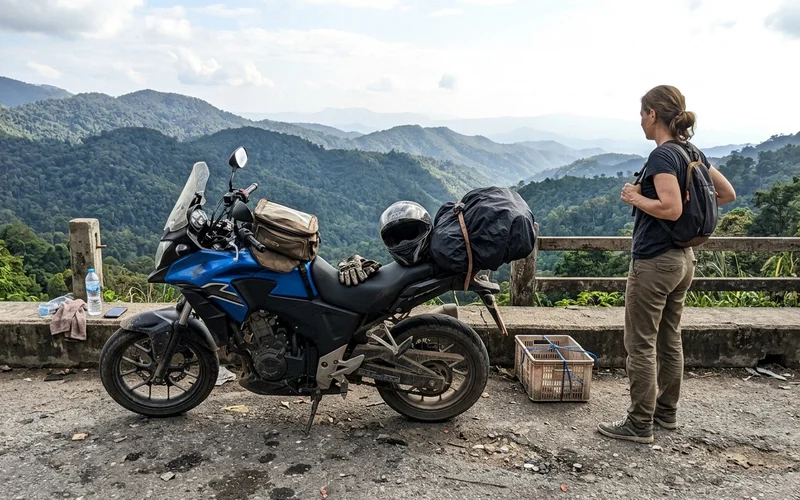
Riding a motorbike through a Chiang Mai rainy season is not a fringe activity. Tens of thousands of people do it every day, in every month of the wet season, and most of them get home fine. But wet roads shrink your margin for error in specific, predictable ways, and tropical rain creates hazards that riders from drier climates often haven’t met before.
This page is about those hazards and how to ride around them — not about whether to visit Chiang Mai in the rainy season, and not about how to rent a scooter. It assumes you already know what the wet months here are like and want a straight answer on riding through them.
Is It Safe to Ride a Motorbike in Chiang Mai During Rainy Season?
For a competent rider on a roadworthy bike, yes, with qualifications. Rain in Chiang Mai typically arrives as intense bursts rather than all-day drizzle, so much of the time the roads are merely damp or actively drying. Ordinary wet pavement, ridden at sensible speeds with smooth inputs, is manageable.
The honest qualifications:
- Wet roads reduce available grip. Everything — braking, cornering, accelerating — has to be done more gently, with more space and more time.
- Tropical downpours are a different event from ordinary rain. When a real storm hits, visibility can collapse within minutes, standing water builds up fast, and continuing to ride stops making sense. Waiting it out is a normal, local behaviour, not a defeat.
- Mountain roads amplify everything. Steep gradients, blind bends, runoff, debris and low cloud make routes outside the city substantially more demanding in the wet.
- Inexperience stacks the risks. If you rarely ride, are new to left-side traffic, or have never ridden in tropical rain, a wet-season downpour in unfamiliar traffic is a hard environment to learn in.
Context matters too. Motorcycling in Thailand carries real risk even in the dry: the WHO’s most recent global road-safety reporting estimates that riders of motorised two- and three-wheelers account for the overwhelming majority of Thailand’s road deaths. That’s a year-round figure, not a rainy-season one, and there’s no reliable evidence isolating a Chiang Mai wet-season crash rate — but it’s a good reason to take the wet months seriously rather than casually.
Why Wet Roads in Chiang Mai Are More Dangerous
Reduced grip
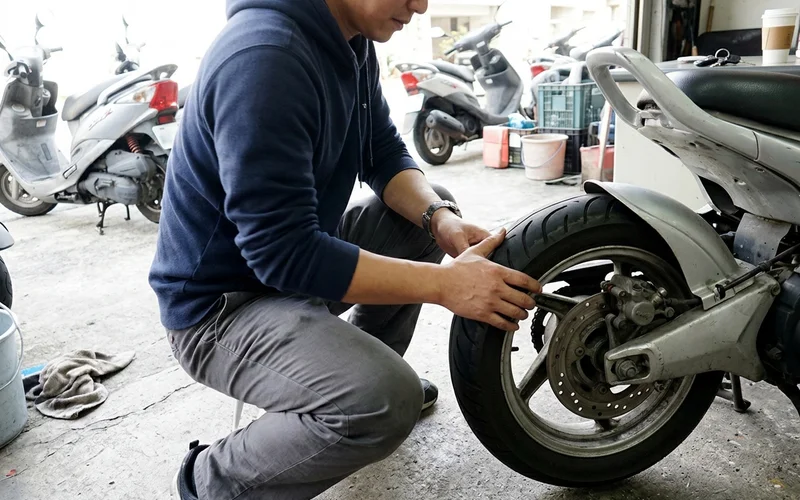
A tyre grips through friction, and water reduces it. On a wet road you have less grip in reserve for braking and cornering, so inputs that would be routine in the dry can exceed what’s available. That’s the whole mechanism — everything else below is a special case of it.
The first rain after dry weather
Road-safety authorities warn that the first rain after a dry spell is often the slickest moment on the road. Oil, grease, rubber and dust accumulate on the tarmac during dry weeks; when rain begins, those contaminants mix with the water and lift into a film before they’re washed away. Oregon’s Department of Transportation, for example, explicitly warns drivers that the first hours of rain after a dry spell bring unexpectedly slick roads.
In Chiang Mai this matters at the start of the season and after any dry break within it. The practical response is simple: treat the first stretch of any shower as the slipperiest, ease off, and let the rain scrub the surface before riding normally.
Painted lines, zebra crossings and metal covers
Painted road markings and metal surfaces are slicker than asphalt when wet. Lane paint and thermoplastic markings sit on top of the surface as a smoother layer, and the Motorcycle Safety Foundation advises riders to avoid shiny, smooth surfaces in the rain. Metal drain covers, manhole covers and bridge plates behave the same way. Chiang Mai’s city centre — the moat roads, the superhighway junctions, zebra crossings everywhere — is dense with both.
You can’t avoid them entirely. Cross them upright, with steady throttle and no braking, and never try to corner or brake hard on top of one.
Standing water and what it hides
A puddle is not just wet road. It can conceal potholes, broken surface, debris, drain covers and abrupt depth changes — and you can’t see the bottom. Slow before you reach water you can’t read, and if you can’t judge the depth, go around it or don’t go through at all. At speed, enough standing water can also lift a tyre onto a film of water — aquaplaning — which is another reason speed is the main variable you control.
Visibility
Heavy tropical rain cuts what you can see and, just as importantly, what drivers can see of you. Spray from trucks and cars makes it worse, a misted or rain-spattered visor worse still, and rain at dusk or night is the worst combination of all. If you can’t clearly see the road ahead and the vehicles around you, the ride has already ended — the only question is whether you stop voluntarily.
How to Ride More Safely in the Rain
None of this is exotic. It’s ordinary riding with every margin widened.
- Slow down. Lower speed buys you time, shortens braking distances and reduces the chance of aquaplaning on standing water.
- Leave much more space. The UK’s Highway Code tells drivers to at least double their following gap in wet weather, and motorcycle training bodies commonly teach a four-second gap in the wet. However you measure it, the point stands: you will need more room to stop, and the vehicle in front can stop no better than you can.
- Brake earlier and more gently. Squeeze progressively rather than grabbing. Abrupt braking is how front wheels lose grip on slick surfaces. If your bike has ABS, it helps — but it doesn’t repeal physics, so still brake early.
- Keep every input smooth. Throttle, brakes and steering should all be rolled on and off, never snapped. Sudden inputs are what break traction when grip is already scarce.
- Take corners slower and more upright. Do your slowing before the corner, not in it, and avoid braking or chopping the throttle while leaned over. On unfamiliar wet roads, assume every blind bend hides gravel, runoff or a slow truck.
- Ride in the wheel tracks of traffic ahead where you can. Car tyres displace water and leave a briefly clearer strip of tarmac.
- Don’t ride through water you can’t judge. This is covered again below, because it’s the mistake with the worst outcomes.
When You Should Stop and Wait Out the Rain

Knowing when to park the bike is a skill, not a failure. Pull over somewhere safe — a shopfront awning, a petrol station, a café — when any of these are true:
- Rain is so heavy that road markings, lane edges or the vehicle ahead are hard to see
- Water is pooling or flowing across the road faster than you can read it
- You’re riding into a mountain area and low cloud or runoff is building
- Wind is strong enough to push the bike around
- Darkness is falling and it’s still raining hard
- You’re tired, cold, or no longer confident in your own inputs
- The Thai Meteorological Department has issued heavy-rain, flash-flood or landslide warnings for the area you’re in or heading toward — TMD regularly warns of flash floods and runoff in northern provinces, Chiang Mai included, during strong monsoon periods
Most Chiang Mai downpours pass within an hour. Waiting costs you an afternoon coffee. Riding on through a storm you can’t see through can cost considerably more.
Mountain Roads During Rainy Season
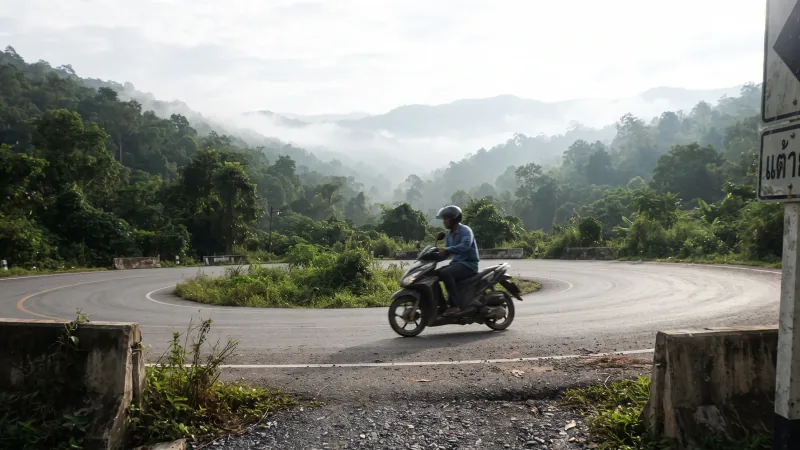
This is where Chiang Mai rainy season motorbike safety stops being generic. The city sits in a valley ringed by mountains, and the most popular rides out of town — Doi Suthep, Mae Rim, Mae Kampong, Chiang Dao, Route 1095 toward Pai — climb into terrain where rain behaves differently.
- Weather diverges fast. It can be drizzling in the city and pouring on the mountain, with low cloud cutting visibility to metres on the upper slopes of Doi Suthep.
- Runoff crosses the road. Water flows down and across mountain tarmac, carrying mud, gravel, leaves and small branches onto the riding line — often just after blind corners.
- Prolonged rain destabilises slopes. Landslides and rockfall are a documented rainy-season hazard in Thailand’s northern mountains; the TMD and disaster authorities issue slope and flash-flood warnings for Chiang Mai and neighbouring provinces most wet seasons. After days of heavy rain, treat steep mountain routes with real caution and check current warnings before setting out.
- Steep gradients punish wet mistakes. Braking downhill on a wet, debris-strewn mountainside has far less recovery room than a flat city street.
None of this means never ride to the mountains in the wet season. It means pick your day: ride up in the dry morning window, come down before the afternoon storms, and if the forecast or the sky says otherwise, go another day. A long, wet, cloudy descent of Route 1095 on a rental scooter is the specific scenario this page exists to talk you out of.
What to Check on a Rental Motorbike Before Riding in the Rain
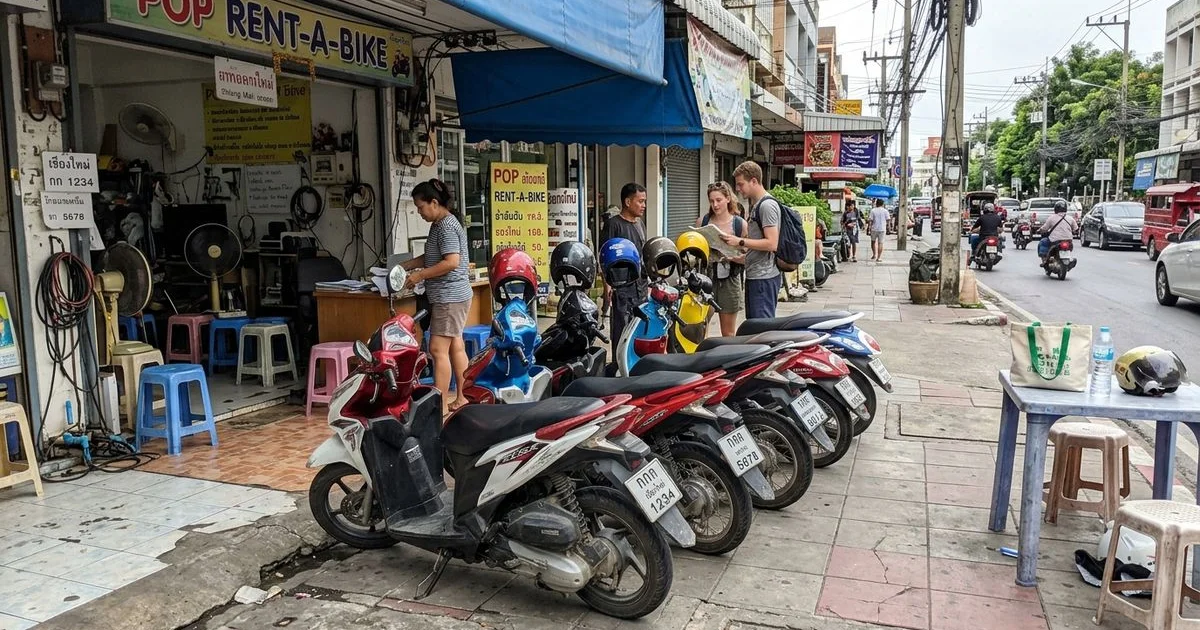
Rental fleets vary, and in the wet season the bike’s condition matters more than usual. Two minutes before you ride off:
- Tyre tread and condition. Bald or cracked tyres are a genuine wet-road hazard — tread is what channels water away. If the tyres look worn smooth, ask for a different bike.
- Tyre pressure, if you can. Badly under- or over-inflated tyres behave poorly on wet tarmac.
- Both brakes. Squeeze the front and press the rear before moving; they should bite firmly, not feel spongy or pull to the bar.
- Headlight, brake light and indicators. You need them working in rain and low cloud — both to see and to be seen.
- Mirrors and horn. Adjust the mirrors; test the horn.
- Helmet. It should fit snugly, have a working strap you can fasten, and ideally a clear, unscratched visor. A visor you can’t see through in rain is its own hazard.
If the shop won’t fix or swap a bike with bad tyres or brakes in rainy season, find another shop. That tells you what their fleet is like.
What Rain Gear Actually Helps
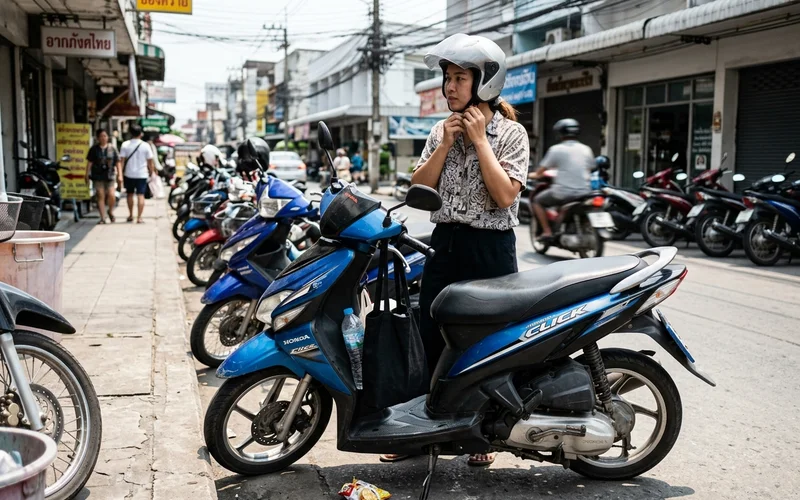
- A fitted rain jacket or two-piece rain suit is the core item. Rider-safety guidance consistently recommends proper rain gear over improvisation — staying dry keeps you warmer, calmer and more focused.
- Be careful with loose ponchos. They’re everywhere in Thailand and they’re better than nothing, but loose material can flap at speed and, on some bikes, risk catching in wheels, chain or controls. If you use one, keep it tucked and secured; a fitted rain jacket is the safer default on a motorbike.
- Footwear with grip. Flip-flops slide on wet pavement when you put a foot down at a junction — exactly when you need your foot to hold. Closed shoes or sandals with a real sole are worth it.
- Gloves keep your grip consistent on wet handlebars and protect your hands if you do go down.
- A waterproof phone pouch matters more than it sounds: a dead phone in a storm in an unfamiliar area means no map and no way to call a ride.
For your helmet: keep the visor clear and unscratched, crack it slightly if it fogs, and never ride with a visor so rain-spattered you’re guessing at the road.
Advice for Inexperienced Riders
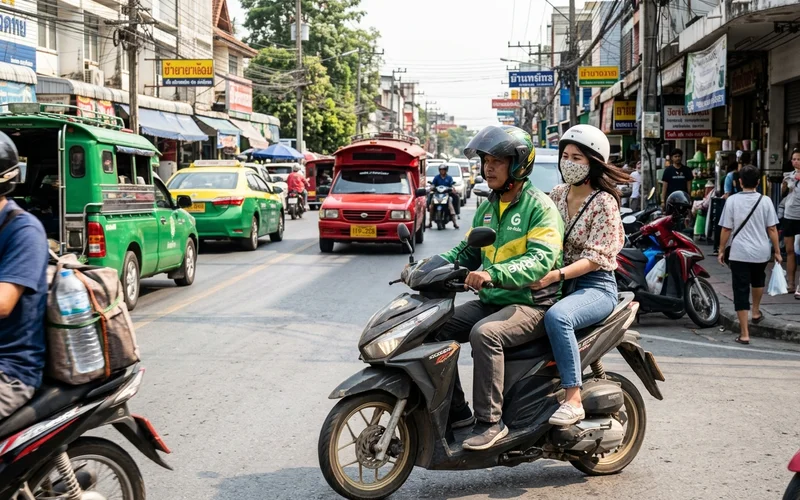
If you rarely ride, have only used scooters occasionally, are new to left-side traffic, or have never ridden in tropical rain, be honest with yourself about the combined load: unfamiliar bike, unfamiliar traffic patterns, unfamiliar weather, all at once.
The good news is that the wet season barely constrains you if you’re flexible:
- Time your rides. Mornings are frequently dry; storms favour the afternoon and evening. Plan riding for the morning window.
- Skip the mountains on wet days. Doi Suthep, Mae Kampong and Pai will still be there when the forecast improves.
- Use the alternatives when the sky turns. Grab cars and bikes, songthaews and taxis are cheap and everywhere in Chiang Mai. Taking one through a downpour isn’t giving up — it’s what experienced residents do when riding stops making sense.
If you do get caught out, the next section applies to everyone, experienced or not.
What to Do if You Get Caught in a Chiang Mai Downpour
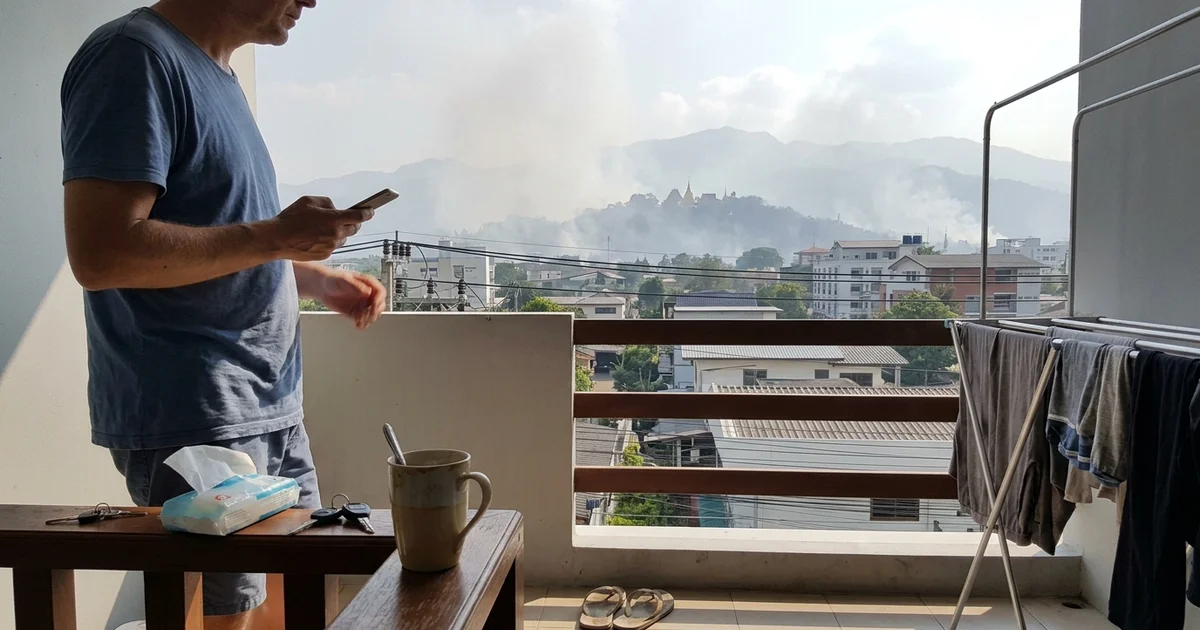
- Don’t panic-brake. Ease off the throttle smoothly and start looking for proper shelter — a petrol station, 7-Eleven awning, café, shopfront. Avoid stopping under large trees in a lightning storm or where water is pooling.
- Pull fully off the road. Other drivers are struggling to see too; don’t stop in a live lane or on a blind corner.
- Put on your rain gear before it soaks through, if you can do it under cover.
- Wait. Most bursts pass within an hour. Use the time to let the road wash clean and your visor clear.
- Restart gently. The road is at its slickest in the early part of a storm and just after, so ride off smoothly and give yourself extra space for the first stretch.
Licences, Helmets and Insurance: The Short Version
This isn’t a legal guide, but three things belong on a safety page because they’re about consequences:
- You need a valid motorcycle licence. Thailand recognises International Driving Permits issued under the 1949 and 1968 conventions, but the IDP only covers categories your home licence covers. If you have no motorcycle entitlement at home, an IDP doesn’t create one — a car licence plus IDP does not authorise you to ride a motorbike here. Police checkpoints in Chiang Mai do check.
- Helmets are mandatory for rider and passenger. Section 122 of Thailand’s Road Traffic Act requires both, and since the 2022 amendment the maximum fine is 2,000 baht; nationwide strict enforcement began in June 2025. Beyond the fine, helmets are the single most effective protection you have — research consistently links them to large reductions in death and head injury.
- Riding unlicensed can void your insurance. Travel and motor insurance policies commonly exclude claims where the rider wasn’t legally licensed. That turns a crash into a personal medical bill. Check your policy before you ride, not after.
Frequently Asked Questions
Is it safe to ride a motorbike in Chiang Mai during rainy season? For experienced riders on a roadworthy bike, generally yes — rain usually falls in intense bursts rather than all day. Wet roads reduce grip and downpours can force you off the road temporarily, so ride with wider margins and be ready to wait out storms.
Are Chiang Mai roads slippery in the rain? Yes — less grip everywhere, and specific spots are worse: painted lines, zebra crossings, metal drain covers, and any road in the first stretch of rain after dry weather, when oil and grime lift into a slick film.
Should I ride a scooter during heavy rain? Ordinary rain, ridden gently, is fine for most riders. Truly heavy tropical rain — where markings disappear and water pools — is when you should pull over and wait. That’s normal practice locally, not an overreaction.
Is it safe to ride from Chiang Mai to Pai during rainy season? Route 1095 is a long, steep, bend-heavy mountain road. In dry conditions it’s a demanding but popular ride; in heavy rain, low cloud or after days of storms, it’s a poor choice, especially on a small scooter or for an inexperienced rider. Go on a clear day, start early, and check weather warnings first.
What should I do if heavy rain starts while I’m riding? Slow down smoothly, put on rain gear if you have it, and look for safe shelter. Most downpours pass within an hour. Don’t stop in a live lane, and don’t push on if you can’t see.
Are mountain roads dangerous during Chiang Mai’s rainy season? They’re more demanding: runoff, mud, gravel, leaves, low cloud and, after prolonged rain, a real risk of landslides. The Thai Meteorological Department issues flash-flood and landslide warnings for northern provinces most wet seasons — check before heading up.
Can I ride through flooded roads in Chiang Mai? Don’t. Floodwater hides road edges, potholes and open drains, and moving water can destabilise or sweep a vehicle — flood-safety agencies advise never entering moving floodwater at all. Turn around and find another route.
What should I check on a rental scooter before riding in the rain? Tyre tread and condition, both brakes, headlight, brake light, indicators, mirrors, horn, and the helmet and its visor. If tyres or brakes are poor, get a different bike.
What rain gear should I wear on a motorbike in Chiang Mai? A fitted rain jacket or rain suit, footwear with grip, and gloves. Loose ponchos are common but can flap and snag — if you wear one, keep it secured. Carry a waterproof pouch for your phone.
Are painted road markings slippery when wet? Yes. Road paint and thermoplastic markings are smoother than asphalt and offer less grip when wet. Cross them upright with steady throttle and no braking.
Should beginners ride scooters in Chiang Mai during rainy season? Beginners face a heavier load: unfamiliar traffic, left-side riding and tropical rain at once. If you do ride, keep to the city, ride in the dry morning window, skip mountain routes on wet days, and use Grab or songthaews when storms build.
Final Thoughts
Rainy-season riding in Chiang Mai is ordinary life for much of the city, and with the right margins — more space, smoother inputs, better gear, a checked-over bike — it’s manageable for anyone who rides competently. The skills that matter most are timing and judgment: ride in the dry windows, respect the first minutes of any storm, stay off mountain roads when the weather is against you, and treat waiting out a downpour as part of the ride rather than an interruption. For the wider picture of what the wet months here involve, see our guide to the Chiang Mai rainy season.
Stay updated
Get the Chiang Mai Brief
Useful local updates, new guides, openings and practical information for living in or visiting Chiang Mai.