
Guides
Is Chiang Mai Humid? Humidity by Season and What It Feels Like
Is Chiang Mai humid? Yes, but how humid Chiang Mai feels depends heavily on the season. See monthly humidity, the muggiest months, and how it compares with Bangkok.
12 min read
By Daniel Calleja, founder of The Chiang Mai Brief and Chiang Mai resident.

Yes, Chiang Mai is humid — but only part of the year. Long-term climate data puts the city’s average relative humidity at around 71%, ranging from roughly half in the driest weeks of the hot season to over 80% at the height of the monsoon. Between December and February, though, Chiang Mai can feel genuinely dry, which is why “yes” on its own is a misleading answer.
How humid Chiang Mai actually feels depends on the season, the temperature and the dew point, not just the humidity percentage on a weather app. This page explains when it is humid, when it is not, why the numbers can be deceptive, and what the conditions feel like day to day.
Is Chiang Mai Humid or Dry?
Both — depending on when you ask. Chiang Mai sits at about 310 metres above sea level in the mountains of northern Thailand, well inland, and that geography gives it a sharper seasonal split than lowland parts of the country.
During the cool season (roughly November to February), relative humidity is moderate and the air is genuinely dry by tropical standards — dew points often sit in the comfortable range, and muggy days are rare. During the rainy season (roughly May to October), humidity climbs to around 71–81%, dew points push into the muggy-to-oppressive range, and the air feels heavy for weeks at a time. The hot season (March and April) sits awkwardly between the two: relative humidity is at its lowest, but the extreme heat means that when moisture does build up late in the season, conditions turn sticky fast.
So “Is Chiang Mai humid or dry?” has no single answer. It is humid in the wet months, comparatively dry in the cool months, and hot more than humid in March and early April.
Chiang Mai Humidity by Season
Chiang Mai has three seasons, and each has a distinct humidity profile. The figures below are long-term averages, so individual days will sit above or below them.
Cool season (November–February): the driest months
This is when Chiang Mai feels least humid. Average relative humidity falls from about 75% in November to the 60s and high 50s by February, and nights are cool — January’s average low is around 15°C (59°F). More importantly, dew points drop well below the muggy threshold. WeatherSpark’s dew point-based data shows just 1.5 muggy days in January and 1.6 in February, so the air typically feels crisp to comfortable rather than sticky. For most visitors, this is the period when humidity is simply not a factor.
Hot season (March–April): driest air, hottest days
March records the lowest average relative humidity of the year — around 52% on the Thai Meteorological Department’s long-term normals, and roughly 47–52% depending on the dataset and period used. But “low humidity” here needs context: April is Chiang Mai’s hottest month, with average highs around 36°C (97°F). Warm air holds more moisture, so even moderate relative humidity at these temperatures means a high absolute moisture content. Days can feel dry and baking in March, then increasingly sticky towards late April as pre-monsoon showers begin to add moisture.
Rainy season (May–October): when the humidity arrives
Humidity climbs steeply from May (around 71%) and stays high all the way through the wet months, peaking at about 81% in August and September. This is also when dew points sit highest, so the air holds the most actual moisture and feels it — WeatherSpark records around 29 muggy days in August alone. Humidity is only one part of the wet-season picture; rainfall patterns, flooding and practical travel considerations are covered in the guide to Chiang Mai’s rainy season. What matters here is that the wet months are when “Chiang Mai is humid” stops being a statistic and becomes something you notice constantly.
Chiang Mai Humidity by Month
The table below shows average monthly relative humidity for Chiang Mai from the Thai Meteorological Department’s 1981–2015 climate normals.
| Month | Average relative humidity | How it tends to feel |
|---|---|---|
| January | 68% | Comfortable; cool, dry nights |
| February | 58% | Dry and warming |
| March | 52% | Driest month; hot and hazy |
| April | 57% | Hottest month; turning sticky late |
| May | 71% | Humidity rising sharply |
| June | 77% | Properly muggy |
| July | 79% | Muggy most days |
| August | 81% | Peak mugginess |
| September | 81% | Peak humidity; heavy wet-season air |
| October | 79% | Still humid, easing late in the month |
| November | 75% | Transitioning back towards dry |
| December | 73% | Cooling and drying quickly |
Annual average: 71%.
When is Chiang Mai most humid?
August and September are the most humid months, both averaging around 81% relative humidity. WeatherSpark’s mugginess data points to August as the peak for perceived humidity, with about 29 muggy, oppressive or miserable days in the month. September’s relative humidity is equally high, so for practical purposes you should treat August–September as the most humid stretch of the year.
When is Chiang Mai least humid?
March is the least humid month by relative humidity, averaging around 52% (roughly 47–52% depending on dataset). If you measure by how the air feels rather than the percentage, December to February is the least humid period: dew points are at their lowest and muggy days are almost nonexistent, with January averaging just 1.5.
Why Relative Humidity Doesn’t Tell the Whole Story
A weather app showing “70% humidity” sounds like a definitive answer, but relative humidity (RH) is exactly that — relative. It measures how much moisture the air holds as a percentage of the maximum it could hold at that temperature. Since warm air can hold far more water vapour than cool air, the same RH figure can mean very different amounts of actual moisture.
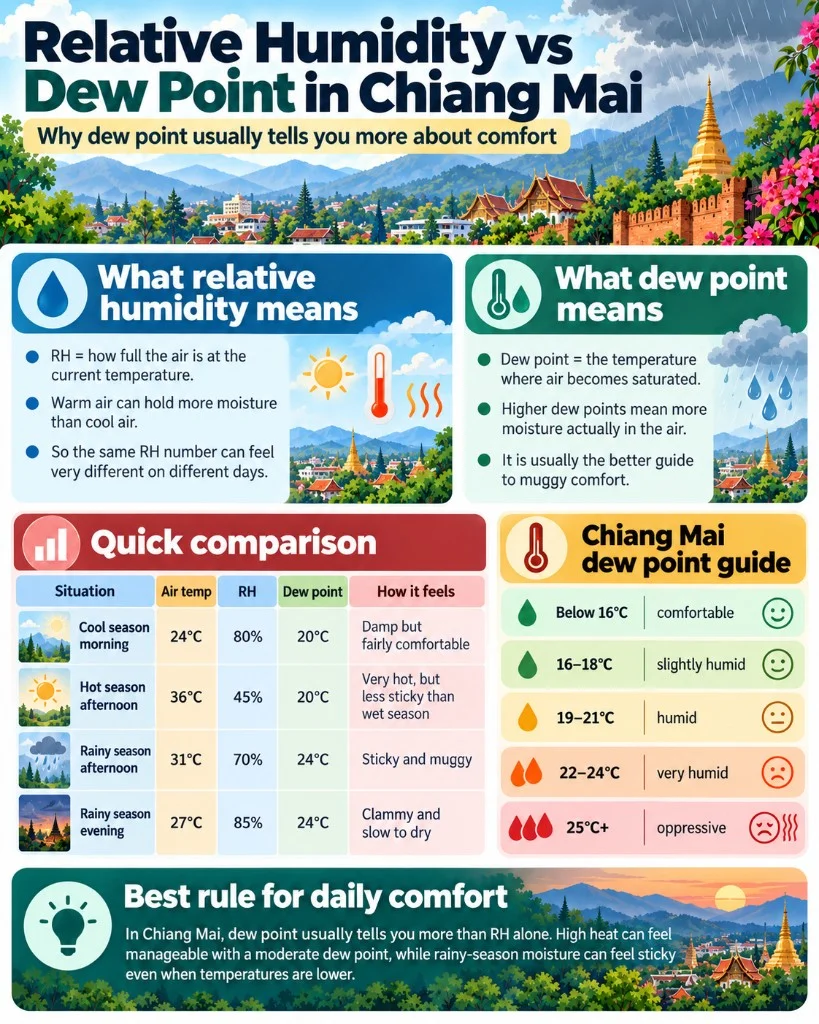
This is why relative humidity is often lower in the afternoon (when the air is hottest) and higher at night and early morning, even when the amount of moisture in the air barely changes. The US National Weather Service puts it plainly: relative humidity alone can be misleading as a guide to how humid conditions feel.
Dew point: the more useful number
The dew point — the temperature at which the air’s moisture would condense — tracks the actual amount of water vapour in the air, regardless of temperature. The higher the dew point, the muggier it feels. The comfort bands used by meteorological sources are roughly:
| Dew point | How it feels |
|---|---|
| Below 13°C (55°F) | Dry |
| 13–16°C (55–60°F) | Comfortable |
| 16–18°C (60–65°F) | Humid |
| 18–21°C (65–70°F) | Muggy |
| 21–24°C (70–75°F) | Oppressive |
| 24°C+ (75°F+) | Miserable |
WeatherSpark’s Chiang Mai data, which is built on dew point, shows a muggy season lasting about 8.3 months (roughly late March to early December), with muggy-or-worse conditions at least 27% of the time. But within that long season, the intensity varies enormously — which is exactly what a single RH figure cannot tell you.
Why 70% humidity doesn’t always feel the same
To make the point concrete, take 70% relative humidity at two temperatures (an illustration using the standard dew-point calculation):
- 70% RH at 20°C — a typical cool-season evening: dew point around 14°C, squarely in the “comfortable” band. The air feels pleasant.
- 70% RH at 35°C — a wet-season afternoon: dew point around 29°C, deep in “miserable” territory. The air feels like a warm, wet blanket.
Same humidity percentage, completely different experience. This is also why December, with a respectable-sounding 73% average RH, can feel dry, while May at 71% feels genuinely muggy — the temperature underneath the percentage is what changes everything.
Is Chiang Mai More Humid Than Bangkok?
It depends on what you measure, and when. The honest answer has two parts.
By relative humidity at the wet-season peak, Chiang Mai is marginally more humid. Chiang Mai’s August–September average RH (around 81%) slightly exceeds Bangkok’s September peak of about 79%. Bangkok’s annual average RH (~73%) is close to Chiang Mai’s (~71%).
By how humid it actually feels across the year, Bangkok is far muggier. Bangkok sits in the low-lying Chao Phraya delta near the coast, and its dew points stay high almost year-round. WeatherSpark’s mugginess comparison makes the difference stark:
| Chiang Mai | Bangkok | |
|---|---|---|
| Length of muggy season | ~8.3 months (late Mar–early Dec) | ~11 months (late Jan–early Dec) |
| Muggy-or-worse at least this share of the time | 27% | 68% |
| Muggy days in the least muggy month | 1.5 (January) | 19.2 (December) |
| Muggy days in August | ~29 | ~31 |
The practical takeaway: Chiang Mai’s wet months are roughly as muggy as Bangkok’s, but Chiang Mai offers a genuine respite. From December to February it has almost no muggy days at all, while Bangkok stays humid even in its “dry” season. Chiang Mai is not a dry-heat city year-round — but it is a city with a real dry season, and Bangkok essentially is not.
What Chiang Mai’s Humidity Feels Like in Daily Life
For visitors
In the cool season, humidity is a non-issue — most visitors never think about it. In the wet months, expect to sweat more, dry more slowly, and feel sticky after even short walks in the middle of the day. Air-conditioned rooms, cafes and shopping centres provide easy relief, and heavy rain often temporarily freshens the air. The main adjustment is practical: quick-dry clothing, a willingness to plan outdoor activity for mornings, and realistic expectations about afternoon comfort. It is manageable, not dangerous, for healthy people who stay hydrated.
Living with it long-term
Residents tend to organise around humidity rather than suffer it. The recurring themes in the wet months are familiar to anyone in the tropics: laundry and towels dry slowly or not at all indoors, leather goods and books can spot with mould in poorly ventilated rooms, and sleep comfort depends heavily on air conditioning or at least good airflow. None of this is unique to Chiang Mai, and the city’s genuinely dry cool season — when windows stay open and nothing feels damp — is a large part of why many long-term residents find the climate easier than Bangkok’s or the southern provinces’.
Indoor versus outdoor humidity
Indoor humidity in Chiang Mai can differ dramatically from the reading outside, depending on the building. Air conditioning dehumidifies as it cools; standalone dehumidifiers are common in wet-season households for exactly this reason. The US EPA recommends keeping indoor relative humidity below 60%, ideally in the 30–50% range, to prevent mould — its core advice is that mould control is moisture control, achieved through ventilation, dehumidification and drying damp materials within 24–48 hours. The World Health Organization links indoor dampness and mould to respiratory symptoms, which is worth taking seriously if you rent a ground-floor room with poor airflow through the wet season. In practice: run the air conditioner or a dehumidifier in August and September, ventilate when outdoor air is drier, and do not leave wet laundry hanging in closed rooms for days.
FAQs
Is Chiang Mai humid?
Yes, but seasonally. Average relative humidity is about 71% across the year, peaking around 81% in August–September and dropping to roughly 52% in March. From December to February the air is comparatively dry and muggy days are rare.
Is Chiang Mai humid or dry?
Both, depending on the season. The rainy season (May–October) is humid and muggy; the cool season (November–February) is comparatively dry and comfortable; the hot season (March–April) has the lowest relative humidity but the highest temperatures, so it can still feel sticky late in the day as the monsoon approaches.
What is the most humid month in Chiang Mai?
August and September, both averaging around 81% relative humidity. By perceived mugginess (dew point), August is the peak, with roughly 29 muggy days in the month.
What is the least humid month in Chiang Mai?
March, at around 52% average relative humidity (roughly 47–52% depending on the dataset). By how the air feels, December–February is the least humid period, with January averaging only about 1.5 muggy days.
Is Chiang Mai more humid than Bangkok?
By peak relative humidity, slightly — Chiang Mai’s wet-season peak (~81%) edges Bangkok’s (~79%). By year-round feel, no: Bangkok is muggy for about 11 months of the year and has nearly 20 muggy days even in its least humid month, while Chiang Mai has a genuinely dry cool season with almost none.
Does Chiang Mai feel humid all year?
No. The muggy season lasts roughly 8.3 months (late March to early December), but December to February is genuinely dry-feeling, with comfortable dew points and almost no muggy days. Even within the muggy season, mornings and nights are usually far more comfortable than mid-afternoon.
Is Chiang Mai humid during the cool season?
Not in any meaningful sense. Relative humidity averages 58–75% from November to February, but temperatures are mild and dew points low, so the air typically feels dry to comfortable. January has only around 1.5 muggy days on average.
Why does Chiang Mai feel more humid during the rainy season?
Rainfall and saturated ground keep adding moisture to the air, pushing both relative humidity and dew points up. August and September combine the wet season’s highest moisture with warm temperatures, which is why the same 80% figure feels far heavier than a humid day in the cool season — the air is holding much more actual water.
Is Chiang Mai always a dry heat?
No — this is a common claim and it is wrong for roughly half the year. March and early April often qualify as dry heat, but from May to October conditions are frequently muggy to oppressive by dew-point standards. What Chiang Mai does have, unlike Bangkok, is a genuinely dry and comfortable cool season.
Stay updated
Get the Chiang Mai Brief
Useful local updates, new guides, openings and practical information for living in or visiting Chiang Mai.