
Living in Chiang Mai
Chiang Mai Burning Season 2027: Dates, Smoke, AQI & What to Expect
Chiang Mai burning season explained: when the smoke arrives, how bad PM2.5 and AQI get in March and April, and how to plan a trip or daily life around it.
By Daniel Calleja, founder of The Chiang Mai Brief and Chiang Mai resident.
Chiang Mai burning season is the annual period when smoke from agricultural burning and forest fires settles over northern Thailand, turning the city’s air hazy for weeks at a time. It typically builds through February, peaks in March and usually lingers into April before the first proper rains clear the air. It matters because it is the one stretch of the year when Chiang Mai’s air becomes genuinely unhealthy, and it shapes decisions for travellers and residents alike.
This guide covers what the season is, when it happens, why the smoke forms, how bad the PM2.5 and AQI can get, and how people plan around it, whether that means timing a holiday, arranging life as a resident or deciding when to leave town for a few weeks.
What Is the Burning Season in Chiang Mai?
It is Chiang Mai’s annual smoke season: a stretch of the dry months when fires across the region push haze into the city and keep it there. Locals also call it the smoky season, and both names describe the same thing: weeks of grey skies, reduced visibility and fine particulate pollution that you can taste in the air.
The haze comes from burning, mostly deliberate. Farmers burn crop residue after the harvest, clear fields for planting and set fires in forests to flush out mushrooms and game. Those fires, thousands of small ones across northern Thailand and neighbouring countries, produce a regional haze that drifts into populated valleys like Chiang Mai’s.
It sits between the cool, clear months of November to January and the arrival of the rainy season around May. In a typical year the city goes from some of its clearest air in December to its worst at the height of the burning, then back to clean, fresh conditions once the rains establish themselves.
The pattern itself is not new. Burning after harvest has been standard practice across the region for generations, and satellite records show the same annual spike in fire activity going back decades. What has changed is the scale and the attention: more farmland under cultivation, more fires, and far more scrutiny as the city has grown and global pollution rankings have turned a regional nuisance into international news. The name is informal, a piece of local shorthand rather than any official designation, but it is the one almost everyone uses, and Thai media now use their own equivalent. It is also worth saying what the haze is not: it is not a constant condition, not mainly a traffic problem, and not uniform even at its height. It is a seasonal, agricultural and fundamentally regional event, which is why most of this guide is about timing and management rather than alarm.
When Is Burning Season in Chiang Mai?
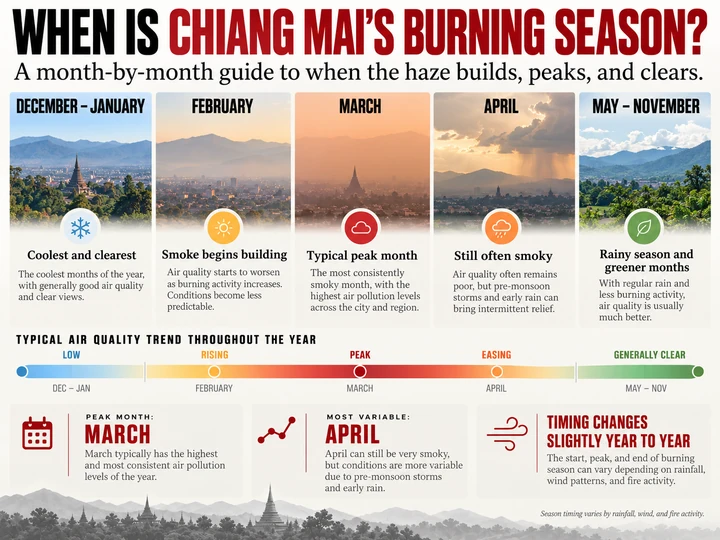
There are no fixed dates, but the pattern is consistent enough to plan around, including when Chiang Mai burning season starts and ends each year. The haze usually starts becoming noticeable in late January or February, once harvesting is done and field burning picks up. It builds through February, is typically at its worst in March, and often remains poor for weeks afterwards until pre-monsoon storms and then the rains bring relief.
Exact timing varies by year. A wet year with early storms can shorten the season noticeably; a dry, hot year can stretch it. El Niño years, which bring hotter and drier conditions to the region, tend to produce worse haze overall. Treat any specific start or end date you read online as an approximation rather than a schedule.
For practical planning, think of February to April as the smoke window and treat it as one block. If you want certainty of clean air, November to January is the reliable window.
Which Months Are Worst for Smoke?
March is usually the worst month. Burning is at its height across the region, the weather is hot and dry with little wind to move the haze along, and the most hazardous air of the year in Chiang Mai typically falls in the second half of the month. April is often nearly as bad early on, though the arrival of thunderstorms later in the month starts to break the pattern.
February is the build-up: some days are fine, others are visibly hazy, and conditions deteriorate as the month goes on. January occasionally sees an early start, particularly in dry years. By May the rains have usually arrived and the worst is over, though a late or weak monsoon can leave residual haze into early June.
The swing from one to the next is real. One year might deliver three weeks of hazardous air at the peak; the next might see it broken up by lucky storms. Anyone planning around the smoke should watch conditions in the specific months rather than assume the calendar.
Why Does Northern Thailand Burn Every Year?
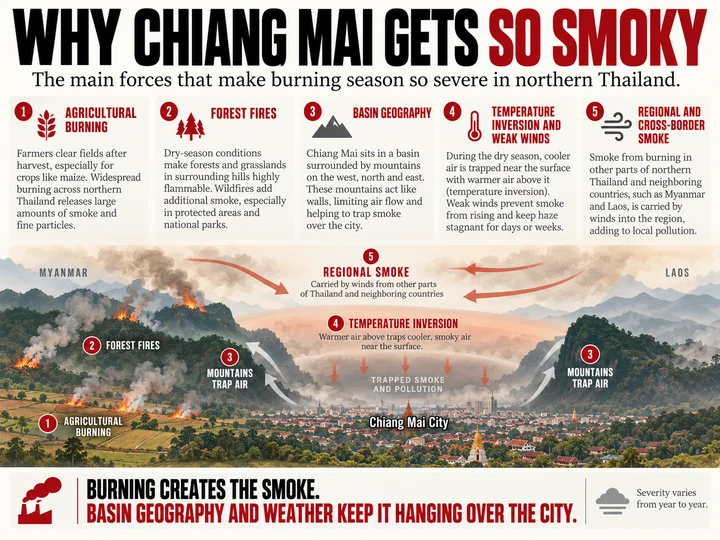
Because fire is cheap, fast and deeply embedded in how farming works here. After the harvest, especially the maize harvest, burning off stalks and residue is the quickest way to clear a field for the next crop. Mechanical clearing costs money that smallholders and contract farmers do not want to spend, and fire remains the default tool across much of the north’s farmland.
Forest fires add a second layer. Some are set deliberately to stimulate wild mushroom growth, clear undergrowth or improve grazing; others start from field fires escaping into the hills. Chiang Mai province and its neighbours record thousands of fire hotspots in a typical dry season, and the output from all of them mixes into the same regional haze.
The Thai government announces burning bans most years, usually covering the peak months, and has experimented with penalties, buy-back schemes for crop residue and promotion of alternatives like baling and ploughing. Enforcement is difficult across tens of thousands of small farms, and the bans have so far reduced rather than eliminated the burning. The deeper economics and policy debate are worth an article of their own; the short version is that the burning persists because it is still the cheapest option available to the people doing it.
The maize trade deserves particular mention because it drives a large share of the field burning. Much of the north’s maize is grown on contract for animal-feed companies, on margins tight enough that farmers will not pay for mechanical residue removal. Burning a field costs a match; clearing it mechanically costs fuel, machinery and labour. Similar economics apply across the border, where maize expansion in Shan State and Laos has added steadily to the regional fire count. This is also why exhortation alone has limited effect. Bans, fines and public campaigns run every burning season, but until residue collection, baling or alternative uses become cheaper than a match, enforcement is fighting the market rather than working with it.
Where Does the Smoke Come From?
Not all of it is local. Fires within Chiang Mai province contribute, but the haze over the city is regional: haze pours in from across northern Thailand and from over the borders in Myanmar and Laos, where burning practices are similar and regulation is weaker. Satellite fire maps from NASA’s FIRMS system show the whole region dotted with hotspots throughout the peak months.
Research tracking the haze confirms what residents see. Studies modelling PM2.5 in the north find that transboundary sources, fires outside Thailand, contribute a significant share of the pollution over Chiang Mai during the peak weeks, on top of domestic agricultural burning. When the wind blows from Myanmar’s burning hills towards the city, the air worsens regardless of what Chiang Mai province itself does.
This is why local burning bans only ever partly solve the problem. Even perfect compliance inside Thailand would leave a large share of the problem untouched, which is a useful thing to understand before assuming any single policy will fix a given year’s season.
Laos follows the same pattern, with burning concentrated in its northern provinces along the Thai border, and the wind decides whose output the city breathes on any given day. A spell of southerly flow brings smoke from Thailand’s own lowland fires; a westerly spell delivers the output from across the border. The net effect, visible on any satellite fire map at the peak, is a basin of fire activity stretching across mainland Southeast Asia, with Chiang Mai sitting downwind of much of it. That regional geography, not any single country’s policy failure, is the core reason the haze has resisted decades of announced crackdowns.
Why Does Smoke Linger Over the City?
Geography is the short answer. Chiang Mai sits in a broad valley ringed by mountains, with Doi Suthep rising immediately to the west and ranges on every side. In the cool season those mountains frame famous views; in the haze months they help trap pollution. A layer of warm air aloft, known as a temperature inversion, acts like a lid during the dry months, holding the smog close to the ground instead of letting it disperse.
Dry-season weather makes it worse: little rain to wash particles out of the air, and often only light winds to push the haze out of the valley. The result is that haze accumulates day after day rather than blowing through. Mornings are frequently the worst time, when overnight inversions are strongest; the smog often lifts visibly by early afternoon as the ground heats up, then settles again after dark.
You can see this cycle yourself from any high viewpoint: a brown-grey layer sitting over the city in the morning, thinning by midday. The same mechanics explain why some days within the season are far worse than others, even while the fires keep burning.
The inversion mechanism also explains the daily rhythm. Overnight the ground cools, the surface layer cools faster than the air above it, and a stable blanket forms that traps particles near the surface. As the sun heats the ground through the morning, the blanket breaks up and the trapped pollution mixes upward and thins. On strong-inversion days the lid persists well into the afternoon; on breezy ones it barely forms at all. Wind direction then decides whose haze the valley receives that day. The same physics explains why the surrounding plains can be hazier than the city centre, and why two neighbouring valleys occasionally show very different readings on the same morning.
Why Has Chiang Mai’s Burning Season Been So Difficult to Solve?
Because the problem sits at the intersection of ecology, economics and governance, and most interventions have tackled only one corner of that triangle.
Start with the fact that fire is functional. For generations, highland communities used controlled burning as part of farming and forest use: clearing plots, encouraging mushrooms and other forest products, holding back undergrowth, with customary rules keeping burns small and well timed. Research on territorial rights and fire in the north, published by the UN’s Food and Agriculture Organization, found that fires on land under common community management tended to stay controlled, while state-managed forest, where local residents were excluded from any management role and felt no ownership, burned more carelessly and more often. In one documented case, fires in a national park increased after a forest village was relocated and officials lacked the staff to replace the watchfulness the villagers had provided.
It also matters what actually burns. A 2023 review by Pirard and Charoenpanwutikul, a synthesis of hundreds of studies of the northern haze, notes that Thai forestry officials’ own surveys attribute most forest fires to the collection of forest products, hunting and land clearing rather than to crop fields, yet national campaigns have concentrated on penalising farmers, in the authors’ analysis, because fields are easier to police than forests. They further argue that the response is hampered by centralisation: provinces cannot spend prevention funds outside their own jurisdiction, central allocations cover only a fraction of what provinces request, and local administrations prioritise droughts and floods that affect voters more directly. That governance critique is their interpretation of Thai policy research, but independent studies of haze management point in a similar direction.
Finally, bans face simple geometry. A prohibition is declared across tens of thousands of square kilometres of forest and farmland, much of it remote, and a share of the haze crosses borders regardless, so purely local enforcement has hard limits. The approaches showing most promise treat fire as something to manage rather than simply forbid: Chiang Mai province’s FireD system, for example, has farmers submit burn requests that officials approve or reject against current conditions, pairing regulation with local participation. Regional cooperation exists through ASEAN’s 2002 transboundary haze agreement, but its consensus-based, non-interference design keeps progress slow. The realistic conclusion is that this yields to sustained management, practical alternatives and cross-border work, not to any single ban.
How Bad Do PM2.5 and AQI Get?
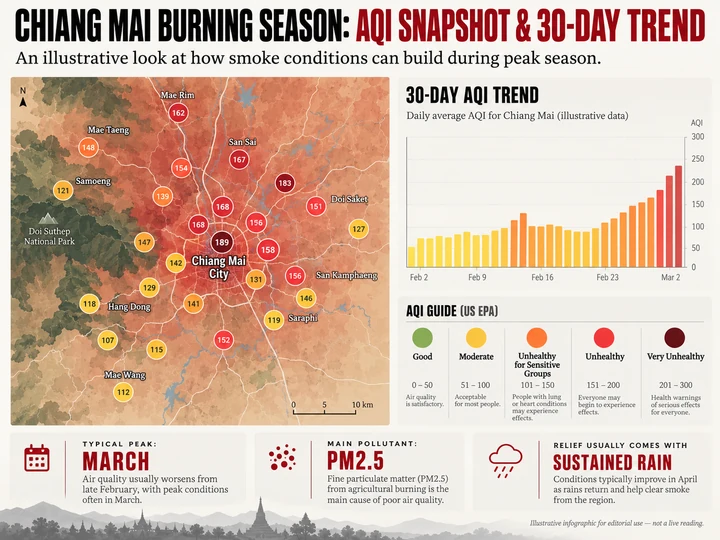
Bad enough to take seriously. PM2.5 is fine particulate matter small enough to reach deep into the lungs, and it is the pollutant that defines the season. The WHO guideline for 24-hour PM2.5 exposure is 15 µg/m³; during peak burning weeks in Chiang Mai, 24-hour levels routinely run many times that figure, and hourly peaks go far higher.
On the AQI scale, ordinary dry-season readings in the city sit in the moderate range. At the height of the haze they climb into the red and purple bands, unhealthy and very unhealthy, and on the worst days readings exceed 300, which is classed as hazardous. In the severe 2023 episode, Chiang Mai repeatedly appeared at or near the top of global pollution rankings, with AQI approaching 290 on the worst afternoons, and severe episodes since then have followed the same pattern.
For perspective, the rest of the year is a different city: from roughly June to January, air quality in Chiang Mai is generally moderate to good, and some mid-year days are genuinely pristine. It is a concentrated problem, not a permanent condition. Anyone tracking it should check Chiang Mai AQI and PM2.5 rather than rely on monthly averages, because conditions swing day to day and even hour to hour.
The numbers are worth understanding properly. PM2.5 means particles of 2.5 micrometres or smaller, roughly thirty times finer than a human hair, and small enough to pass from the lungs into the bloodstream. The WHO’s 24-hour guideline of 15 µg/m³ is the relevant international yardstick. Thailand’s own national standard, tightened to 37.5 µg/m³ over 24 hours in 2023, is still more than double that figure, so a day can be within the local limit and far above international guidance at the same time. During the peak, 24-hour readings in the city commonly sit well into triple digits, and hourly levels climb far higher on still mornings. That gap between the local standard, the WHO guideline and actual peak readings is the context behind every ranking headline and every official warning.
What Is Burning Season Like Month by Month?
The broad shape below describes a typical year. Individual years shift by a week or two in either direction, so use it as a planning framework rather than a promise. For PM2.5 and AQI across all twelve months, see Chiang Mai air quality by month.
| Month | Typical conditions |
|---|---|
| December to January | Cool, clear and largely smoke-free; the clearest air of the year |
| February | Haze builds; hazy days become common, mornings worst |
| March | Height of the burning; the worst air of the year, often hazardous |
| April | Haze continues early on; heat peaks; storms begin to clear the air late in the month |
| May | Rains arrive; skies clear and air quality returns to normal |
| June to November | Clean and green; air pollution rarely an issue |
Is Chiang Mai Safe During the Smoke?
For most healthy adults, a few weeks of smoke is an unpleasant irritant rather than a catastrophe, but it is real pollution and the honest answer is more nuanced than either extreme you will read online. PM2.5 exposure causes coughing, sore throats, itchy eyes and a runny nose in plenty of otherwise healthy people during bad spells, and short-term exposure at these levels is linked to increased respiratory and cardiovascular symptoms.
The groups who should treat the season as a serious health issue are people with asthma or other lung conditions, heart disease, young children, the elderly and pregnant women. For them, weeks of hazardous air carry meaningful risk, and planning around it, whether through strict indoor measures or temporary relocation, is sensible rather than precious.
Long-term health effects relate mostly to repeated, prolonged exposure over years rather than a single season, but nobody should pretend it is harmless because it is familiar. The calm approach is to respect it, manage exposure, and keep it in proportion: millions of people live with this every year, and the coping strategies below are well proven.
The mechanism behind those symptoms is straightforward irritation plus inflammation: fine particles lodge in the airways and, in sufficient concentration, trigger the body’s defences. Healthy adults usually recover quickly once exposure drops, which is why afternoons outdoors feel so different from mornings and why a few clean storm days bring such noticeable relief. What the evidence does not support is complacency over many seasons: repeated heavy exposure is associated with worse long-run respiratory and cardiovascular outcomes, one reason public pressure on the government has grown steadily. For a visitor spending two weeks in town, the sensible frame is comfort plus modest caution. For anyone settling in the city, the calculus shifts toward managing cumulative exposure across many runs of the haze, through purifiers, masks, monitoring and, for some, a standing plan to be elsewhere at the peak.
Should You Visit During the Haze?
You can, and plenty of travellers do, but go with your eyes open and your dates chosen carefully. Outside the core weeks the risk is modest: a trip in early February might catch nothing worse than a hazy morning or two, and the final stretch often improves quickly once storms arrive. During the peak, though, the Chiang Mai smoke can dominate a holiday rather than merely inconvenience it. On bad days the surrounding hills disappear entirely, the famous view from Doi Suthep reduces to a grey wall, and a full afternoon outdoors stops being pleasant for anyone, let alone children or travellers with asthma.
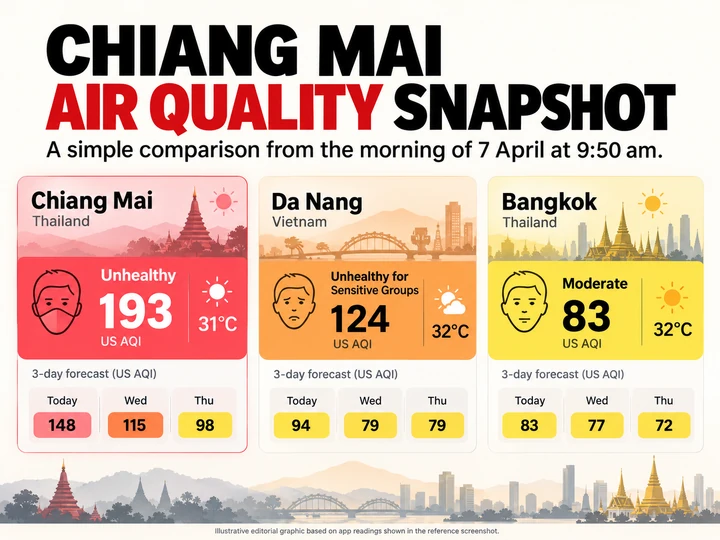
The city itself keeps functioning. Cafes, restaurants, markets, temples and cooking classes all operate as normal, and indoor life carries on much as usual. But tourism numbers show how many visitors vote with their feet: in the severe 2023 episode, hotel bookings fell to about 45 percent occupancy against the 80 to 90 percent normally expected in the run-up to Songkran, according to the Thai Hotel Association’s northern chapter. That tells you two useful things: you will find rooms and sometimes lower prices, and a large share of other visitors decided the burning season was not worth it.
If your dates are flexible, the simplest answer is to come between November and January instead, when the air is clear, the days are cool and the views go on forever. If your trip is already booked for the peak weeks, do not panic. Check the current readings a few days out, plan a mix of indoor activities, and accept that some days will be spent inside. Long-tail boat trips and jungle treks can wait; the city’s food, coffee and craft scenes do not depend on visibility.
One strategy many repeat visitors use is to split the trip. A few days in the city, then a flight south. Phuket, Krabi and the southern beaches sit well outside the northern Thailand haze zone, and travellers who combine the two often describe it as the best of both: the north’s culture and food, then clean sea air when the haze peaks. If you are weighing up places for a two-centre trip, pairing Chiang Mai with Phuket during the burning season months is a genuinely practical option rather than a compromise.
What is not sensible is pretending the haze will not affect you. If your dream trip is built around trekking, mountain views and long stretches outdoors, the peak weeks are the wrong time, full stop. If your trip is flexible in the other direction, arriving for the tail end often works well: prices are still soft, crowds are thin, and the first storms clear the sky fast.
What Is Life Like for Residents?
Life continues, but the rhythm changes. Ask anyone who has lived through a few burning seasons and they will describe the same routine: check the readings first thing in the morning, decide whether it is a windows-closed day, and plan outdoor errands around the afternoons when the haze usually lifts a little. Mornings at the peak can be genuinely grim; by mid-afternoon many days improve enough for a walk or a bike ride, and locals learn to grab those hours.
Schools keep children indoors when levels climb, offices hand out masks, and convenience stores sell out of the good ones. Purifier sales spike every February, delivery riders work through the worst of it, and outdoor workers, who have the least choice in the matter, carry the heaviest exposure. Gyms, malls and cinemas all get busier; outdoor boot camps and running clubs quietly suspend themselves.
The smoky season also reshapes social plans. Weekend trips into the hills are postponed, rooftop bars empty out on bad evenings, and conversation turns to readings the way other cities talk about football. Residents compare apps, swap tips on purifier filters and debate whether this one is worse than the last. It becomes the shared background noise of life for a few weeks, and then it ends, and everyone stops talking about it until the following February.
A visible minority of residents simply leave. Families with young children, people with asthma, and remote workers with no fixed reason to stay often book two or three weeks in Bangkok, on the southern islands or back in their home countries, timed to the peak, as set out in our guide on where to escape the smoke. Those who stay tend to treat it as the price of admission: ten months of the year when the air is clean, the cost of living is low and the hills are on the doorstep. That framing is not denial; it is a deliberate calculation that most long-term residents have made consciously.
None of this makes the haze trivial. The burning season is the single biggest quality-of-life complaint among foreigners living in Thailand’s north, and the reason some people eventually decide the city is not for them. But the day-to-day reality is more mundane than the headlines suggest: a few weeks of adjusted routines, indoor exercise and masks, inside a city that otherwise keeps working.
Practical details matter too. Filter replacements sell out at the peak, so experienced residents stock one spare per unit before February. Hardware stores and online sellers both raise prices once the haze arrives, sometimes sharply. Expats swap recommendations in local forums and building group chats, and landlords of better condos have started advertising sealed windows and included purifiers as selling points. None of this is dramatic; it is simply how a city adapts to a known, recurring problem.
How Can You Protect Yourself Indoors?
The strategy that works is boring and proven: keep the haze out of your lungs by keeping it out of your immediate environment, and filter what gets in. The combination of closed windows, a good purifier and a proper mask outdoors reduces personal exposure dramatically, and it is what long-term residents, schools and hospitals all converge on during the burning season.
A basic protective setup looks like this:
- A HEPA air purifier in the room where you sleep, sized correctly for the room and run continuously, not just when the haze looks bad
- Well-fitting N95, KN95 or KF94 masks for any extended time outdoors
- Windows and doors closed on hazy days, with obvious gaps sealed where practical
- A live readings app so decisions are based on numbers rather than how the sky looks
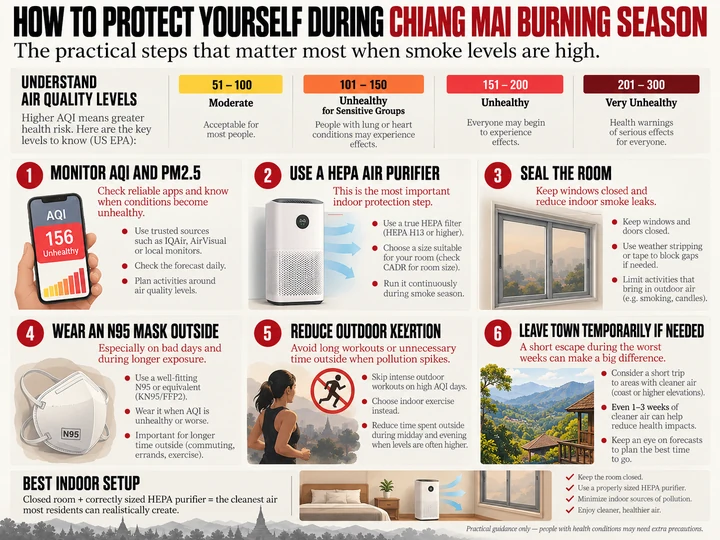
The purifier is the single highest-impact purchase; our guide to the best air purifiers for Chiang Mai covers sizing and filters. In a closed room, a correctly sized unit brings indoor PM2.5 levels down to a small fraction of what is outside within an hour or two, and keeping it running holds them there. The bedroom matters most, because you spend a third of your life breathing it. A second air purifier for the main living space is the common upgrade; whole-house filtration is unnecessary for most rentals, since sealing and treating one or two rooms is enough. Filters clog faster than the box suggests during heavy haze, so keep a spare.
Masks are the outdoor half of the equation, but only the right ones. PM2.5 particles are far too small for cloth or standard surgical masks to stop; health agencies such as the US EPA recommend a well-fitting respirator, an N95 or equivalent, for wildfire smoke, and the same applies here. Fit matters as much as the rating: a gap at the nose or cheeks lets unfiltered haze straight in. If you will be outside for more than a few minutes on a bad day, wear one.
Behaviour is the third layer. Move exercise indoors when levels are high, since exertion multiplies the volume you inhale. Set the aircon to recirculate rather than fresh-air mode. Wet-mop floors and damp-dust surfaces instead of dry sweeping, which just resuspends particles. And check the readings before making plans: mornings at the peak are often several times worse than mid-afternoon, so shifting a run or a market trip by a few hours can cut exposure more than any gadget.
For the vulnerable groups identified earlier, asthma sufferers, heart conditions, young children, the elderly and pregnant women, these measures move from sensible to essential, and stricter versions apply: purifiers in every occupied room, masks for any outdoor time at all, and a low threshold for simply leaving town during the worst spell. Anyone with a respiratory condition should also keep medication close and know where the nearest hospital is, not because emergencies are common, but because haze weeks are the wrong time to improvise.
One thing not to do is rely on folk measures. Spraying water, burning candles or incense, and most air-purifying plants do nothing meaningful against PM2.5; some add particles of their own. The boring version, sealed room, HEPA filter, proper mask, is the one that the evidence on air pollution actually supports.
How Do You Monitor Conditions Day to Day?
The simplest habit is to check a live map each morning before making plans, just as you would check the forecast. Conditions during the burning season swing too much, hour to hour and neighbourhood to neighbourhood, for generalisations to be useful, and the numbers take ten seconds to read.
Three tools cover almost everything. Thailand’s Pollution Control Department runs the official monitoring network and publishes readings through its Air4Thai app and website, including the stations in and around Chiang Mai. IQAir aggregates official and community sensors into a map and app that most foreigners end up using, with colour-coded bands from green through to hazardous maroon. And for the bigger picture, NASA’s FIRMS fire map shows active hotspots across the region in near real time, which tells you whether new smoke is likely to keep arriving from upwind.
A few habits make the numbers more useful. Look at PM2.5 rather than only the headline AQI figure, because PM2.5 is the pollutant doing the damage here. Watch the trend over several hours rather than a single reading: a falling line means windows might open later, a rising one means they stay shut. And learn the daily rhythm, mornings worst, afternoons usually better, evenings sliding back, because it holds reliably enough at the peak to plan errands, exercise and school runs around it.
One caveat: different apps sometimes show different numbers for the same hour, because they draw on different stations and sensor types. Community sensors are numerous but vary in quality; official stations are fewer but calibrated. When they disagree, trust the direction of the trend rather than the exact figure, and err on the side of the worse reading if you are in one of the vulnerable groups.
The colour bands translate the numbers into decisions. Green and yellow mean normal life. Orange is the sensitive-groups warning: children, the elderly and anyone with lung or heart conditions should cut prolonged outdoor exertion. Red means everyone feels it and outdoor exercise stops making sense. Purple and maroon, very unhealthy and hazardous, are stay-indoors readings, and they are not rare at the peak. The bands come from the US EPA’s index, which is what most apps display, though Thailand’s own index uses different thresholds, one more reason the same hour can look different across apps.
When Does the Haze Finally Clear?
The first relief usually arrives with the pre-monsoon thunderstorms in the second half of April. They are scattered at first, one storm can scrub the sky clean for a day while the fires keep burning around it, but each one weakens the pattern. By the Songkran holiday, the end is often in sight even if the haze has not fully gone.
The real finish line is the monsoon itself. Once the rains establish in May, the change is dramatic and fast: fires go out, dust and particles are washed from the atmosphere, and PM2.5 concentrations collapse. NASA’s Earth Observatory, looking at multi-year satellite and sensor records, describes readings near 100 micrograms per cubic metre at the peak falling to between 5 and 10 once the rains return. Residents describe the same thing less formally: one week of proper rain and the smog is simply gone, the ridgelines reappear and the city looks washed.
Two caveats keep this honest. A late or weak monsoon pushes the finish line back, and residual haze can linger into early June in stubborn years. And the clearing is not perfectly linear: a hot, still spell between storms can briefly bring levels back up before the next rain knocks them down again. The broad shape, though, is reliable. Bad through the peak, broken increasingly by storms, finished by the established rains, and then five to six months of the cleanest skies the city sees.
That reliability is what makes planning around the burning season possible at all. Nobody can tell you which specific week will be worst, but the calendar of the exit is steadier than the calendar of the peak.
Frequently Asked Questions
Short answers to the questions that come up most often about the burning season.
When is the best time to visit instead?
November to January is the premium window: cool, dry and clear, with long views and the haze months still ahead. October and the first half of February are workable shoulder options with some risk attached. The wet months, roughly June to September, bring frequent rain but genuinely clean conditions, and the city and countryside are at their greenest. The only stretch most visitors should actively avoid is the peak of the haze, roughly late February until the Songkran holiday, and even then, plenty of people visit and enjoy themselves with adjusted expectations.
Do air purifiers actually work?
Yes, and the difference is large enough to measure. A purifier with a true HEPA filter, run continuously in a closed room, typically brings indoor particle counts down to a small fraction of outdoor readings within a couple of hours. The caveats are sizing, an undersized unit in a large room cannot keep up at the peak, and discipline: opening windows for an hour undoes the work. Purifiers do nothing outdoors, which is what masks are for. But for making a bedroom or living room safe through the haze months, they are the single most effective purchase a resident can make, and the one locals recommend first.
Which apps show current readings?
The two most used are Thailand’s official Air4Thai app from the Pollution Control Department, which publishes the government monitoring stations, and IQAir, which combines official and community sensors into a colour-coded map with hourly updates. For fire activity rather than air readings, NASA’s FIRMS map shows active hotspots across the region in near real time. Whichever you use, the trend over several hours matters more than any single number, and mornings are usually the worst part of the day at the peak.
Does the haze affect flights?
Rarely in practice. Chiang Mai’s airport operates normally through the haze months, and scheduled cancellations purely because of visibility are uncommon, though occasional delays and disrupted landings do happen when conditions are at their very worst. The more common travel impact is indirect: travellers changing their own plans. If you are flying in during the peak, assume your flight will run, but keep the rest of the itinerary flexible enough to spend hazy stretches indoors or further south. Travel insurance is worth a mention here too: standard policies treat the haze as a known condition rather than an unforeseen event, so trip-cancellation claims purely because of poor readings are rarely successful. Flexibility in bookings matters more than cover.
Sources
- Pollution Control Department (Thailand): Air4Thai: official air-quality monitoring network and live station readings. Source
- World Health Organization: Ambient (outdoor) air pollution and health, including the 24-hour PM2.5 guideline. Source
- US Environmental Protection Agency: respirator (N95/P100) guidance for smoke exposure. Source
- WRF-Chem modelling study (via PubMed Central): biomass-burning haze and transboundary contributions over the north. Source
- Aerosol and Air Quality Research: peer-reviewed research on the northern haze episode and its sources. Source
- Reuters (10 April 2023): Pollution choking Thailand’s north hits tourism, worries public. Source
- NASA FIRMS: near-real-time active fire and hotspot maps. Source
- NASA Earth Observatory (8 April 2024): Hazy Skies in a Growing City: multi-year PM2.5 patterns. Source
- IQAir: Chiang Mai live readings, maps and historical rankings. Source
- Pirard, C.P.F. & Charoenpanwutikul, A. (2023): Comprehensive review of the annual haze episode in Northern Thailand (EarthArXiv preprint; not peer-reviewed). Source
- Chiang Mai Doctor (Cassian Pirard PhD): Burning Season: plain-language summary of the 2023 review. Source
- FAO: Forest fire in the context of territorial rights in northern Thailand (community fire management and state forest policy). Source
- Reasons to be Cheerful (26 July 2024): Chiang Mai’s FireD burn-request system. Source
- Bangkok Post (27 February 2025): Price controls on air purifiers, vacuum cleaners expected: Commerce Ministry response to PM2.5-driven price increases and shortages. Source
Guides
Air Quality guides
Every evergreen guide we've published on air quality & burning season in Chiang Mai.
How often
Chiang Mai Air Quality by Month: Cleanest & Worst Months
Chiang Mai air quality by month: the cleanest and worst months, how PM2.5 levels shift through the year, and when burning-season haze peaks and clears.
14 min read
Comparison
Best Air Purifiers for Chiang Mai (HEPA Buyer Guide)
Choose an air purifier for Chiang Mai's smoke — HEPA H13/H14 and CADR explained, Xiaomi, Coway, Levoit and Blueair compared, and room sizing.
7 min read
Step by step
How to Check AQI & PM2.5 in Chiang Mai
Monitor Chiang Mai air quality reliably — IQAir vs Air4Thai, reading PM2.5, what the numbers mean and setting alerts.
5 min read
How often
When Is Chiang Mai's Burning Season? (Dates)
When Chiang Mai's smoke season starts, peaks and ends — a month-by-month timeline, the historical AQI pattern and year-to-year variation.
6 min read
Scenario
Where to Escape the Smoke: Burning-Season Getaways
Cleaner-air destinations to escape Chiang Mai's peak smoke — coastal and island options, higher-altitude escapes, timing and budget notes.
5 min read
Newsletter
Occasional emails with useful Chiang Mai updates, new openings and guides worth knowing about.
The Chiang Mai Brief
Occasional emails with useful Chiang Mai updates, new openings and guides worth knowing about.