
Guides
Best Time to Visit Chiang Mai: Seasons, Weather and Burning Season
Best time to visit Chiang Mai: compare cool, hot and rainy seasons, month-by-month weather, burning season smoke, festivals, crowds, prices and packing tips.
29 min read
By Daniel Calleja, founder of The Chiang Mai Brief and Chiang Mai resident.
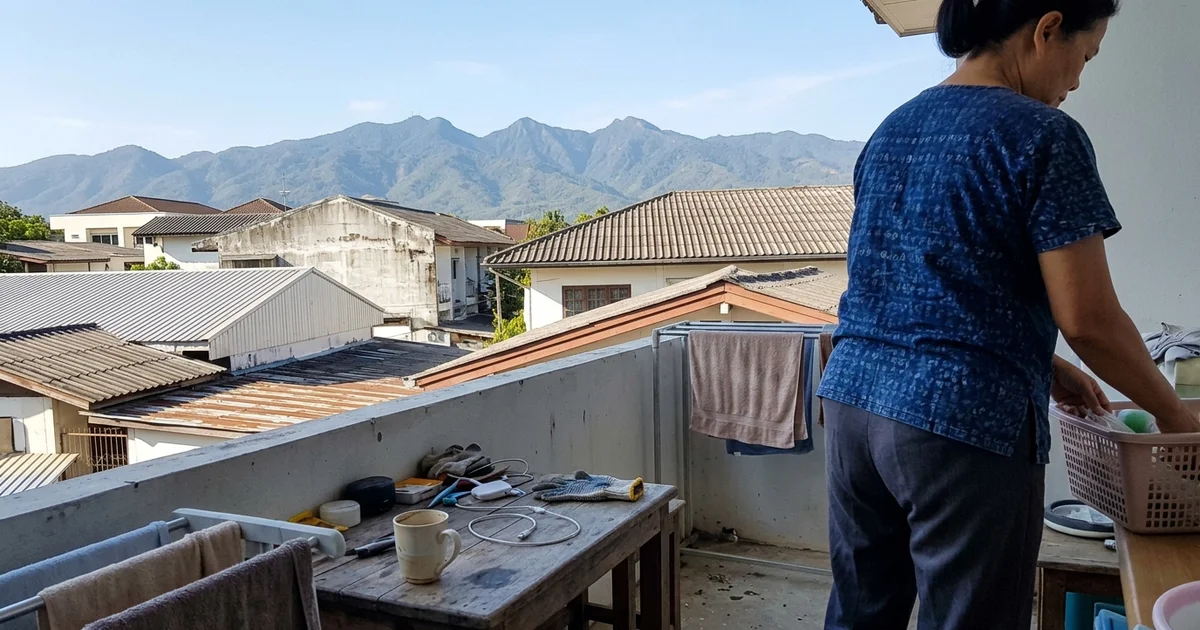
For most travelers, the best time to visit Chiang Mai is from November to February. During these months the weather is at its coolest and driest, humidity is low, rain is rare and the skies are usually clear. Late November through January is the sweet spot: comfortable mornings, warm but manageable afternoons and air quality that is still good before the annual smoke season builds.
There is no single perfect month for everyone, though. February fades into the burning season. April is extremely hot but hosts Songkran, Thailand’s biggest festival. The rainy months from June to October bring the greenest scenery, the fullest waterfalls and the lowest prices of the year. The best time to visit Chiang Mai depends on what you want from the trip, so this guide walks through all three seasons, the smoke that overlaps them, month-by-month weather, festivals, crowds and costs.
The Best Time to Visit Chiang Mai at a Glance
If you just want the headline answer, the best time to visit Chiang Mai for weather is November to February, the cheapest time is June to September, the festival peaks are November and April, and the period to think twice about is March. The details by season:
| Period | Months | Typical weather | Best for | Watch out for |
|---|---|---|---|---|
| Cool season | November to February | 15 to 30 °C, dry, low humidity | First visits, trekking, festivals, motorbike trips | Peak crowds and prices in December and January; smoke from late February |
| Hot season | March to May | 23 to 37 °C, very dry, then first storms | Songkran, lower prices in May | Extreme heat in April; the worst smoke of the year in March |
| Rainy season | June to October | 22 to 33 °C, humid, short heavy showers | Waterfalls, green scenery, budget travel, fewer crowds | Occasional flooding in September and October; muddy trails |
| Burning season | Roughly February to April, peaking in March | Hazy skies, poor air quality | Few reasons to choose it | High PM2.5 levels and reduced visibility |
The burning season is not a separate climate season. It overlaps the late cool season and the hot season, and it matters enough to get its own section below. Temperatures and rainfall in this guide are long-term averages, and any single year can run hotter, wetter or smokier than the norm.
How Chiang Mai’s Three Seasons Work
Chiang Mai sits in a mountain-ringed valley in northern Thailand at about 300 metres above sea level, several hundred kilometres north of Bangkok. That geography gives it a more pronounced seasonal rhythm than the south of the country: genuinely cool nights in winter, a fiercely hot spring and a monsoon summer.
The Thai Meteorological Department officially divides the year into three seasons based on the monsoon winds that drive Thailand’s seasonal weather patterns. Unlike the beaches and islands of the south, where Phuket and Koh Samui follow different monsoon calendars, Chiang Mai has one clear three-season rhythm. The rainy season runs from roughly mid-May to mid-October under the southwest monsoon. The cool season, which the department calls winter, runs from roughly mid-October to mid-February under the northeast monsoon. The hot season, or summer, fills the gap from roughly mid-February to mid-May before the rains return.
In practice, most travel advice rounds these boundaries to calendar months: cool season from November to February, hot season from March to May and rainy season from June to October. Both framings are reasonable. The transitions are gradual, and the exact week the rains start or stop changes every year.
Why the Burning Season Is Not a Fourth Season
You will often see Chiang Mai described as having a fourth season, the burning season or smoky season. It is better understood as an air quality event layered on top of the calendar. Agricultural burning and forest fires across northern Thailand and neighbouring Myanmar and Laos send smoke into the region’s valleys from around late January or February until the first proper rains arrive, usually in April or May. March is typically the worst month. Because the smoke overlaps the end of the cool season and most of the hot season, it reshapes the practical answer to when to visit: the comfortable, clear dry season effectively ends earlier than the weather alone would suggest.
How Much the Seasons Vary From Year to Year
Season boundaries are approximations, not fixed dates. Some years the cool season lingers pleasantly through February; in others the smoke arrives early and cuts it short. Some rainy seasons open with heavy storms in May; others stay fairly dry into June. Dry seasons vary in length just as wet seasons vary in intensity, and weather conditions in the same calendar week can differ noticeably from one year to the next. Thai government hotspot and air quality data show large differences between years, which is why this guide gives ranges rather than exact dates, and why checking conditions close to your travel dates is always sensible.
Cool Season in Chiang Mai (November to February)
Cool Season Weather
The cool season is the most comfortable time of year in Chiang Mai. In December and January, daytime highs average around 29 to 30 °C and nights drop to about 14 to 16 °C in the city, occasionally lower after a cold front arrives from China. Humidity falls to its lowest levels of the year, rainfall is almost negligible (January is the driest month, with around 10 mm on average) and the sun shines most days. Mornings in December and January can feel genuinely chilly, especially on a motorbike or up in the hills, so a light jacket earns its place in your bag.
November is a transition month in the best sense: the rains taper off, the countryside is still deep green and the air is washed clean. February stays dry and sunny, but daytime highs climb toward 33 °C and from mid or late February the first haze of the burning season usually appears.

December and January: The Busiest Weeks
The cool season is also peak tourist season. December and January are the busiest months of the year in Chiang Mai, with a further spike around Christmas and New Year. The night markets, the old city temples and popular day trips all draw their biggest crowds, and accommodation prices reach their annual high. The Yi Peng and Loy Krathong festival period in November is so popular that central hotels often sell out months in advance. If you want peak-season weather without peak-season congestion, the first half of November and the middle weeks of January, after the New Year rush, are usually the calmest pockets.
Cool Season Highlights
- Yi Peng and Loy Krathong in November, the lantern festivals many people plan entire trips around.
- Cool, dry trekking conditions in the mountains, with clear views and wildflowers early in the season.
- Thai sakura (wild Himalayan cherry blossom) flowering around the Hmong village and research station at Khun Chang Khian and at Khun Wang, usually from late December into January.
- The Chiang Mai Flower Festival, normally held on a weekend in early February.
- Chinese New Year, which falls in late January or February and brings lion dances and street food to the Chinatown area around Warorot Market.
Hot Season in Chiang Mai (March to May)
The hot season builds quickly. By March, daytime highs average around 35 °C and the dry countryside turns brown. The heat combines with the peak of the burning season, so March is the month most long-term residents would least recommend for a first visit.

April: The Hottest Month and Songkran
April is the hottest month of the year in Chiang Mai, with average highs around 37 °C and individual days pushing past 40 °C. Sightseeing is best done early in the morning and again in the late afternoon, with an air-conditioned break in between. This is the season for indoor escapes: shopping malls, cinemas, spas and thai massage, cookery classes and muay thai gyms. Humidity starts to climb, and the first pre-monsoon storms can arrive late in the month.
April also brings Songkran, the Thai New Year, on fixed national holiday dates from April 13 to 15. Chiang Mai hosts one of the biggest Songkran celebrations in Thailand: several days of city-wide water fights around the old city moat, parades and a Buddha image procession along Tha Phae Road, with festivities often spilling a day or two beyond the official holiday. Songkran was added to UNESCO’s Representative List of the Intangible Cultural Heritage of Humanity in December 2023. If you visit in April, expect to get soaked, book accommodation well ahead and protect electronics in waterproof pouches. If you dislike crowds, noise and heat, April is a month to skip.
May: First Storms and Falling Prices
May stays hot, with highs around 35 °C, but the character of the month shifts as the southwest monsoon approaches. Humidity rises, rain days increase and the first proper downpours usually arrive, clearing the air and starting the transition to the rainy season. May is a genuine shoulder period: visitor numbers drop, hotel prices fall and the smoke season ends once the rain sets in. Travelers who can handle heat and the odd afternoon storm often find May underrated.
Burning Season in Chiang Mai: What You Need to Know
The burning season, also called the smoky season, is the single biggest factor that catches first-time visitors off guard, so it deserves a clear explanation.
What Causes the Smoke
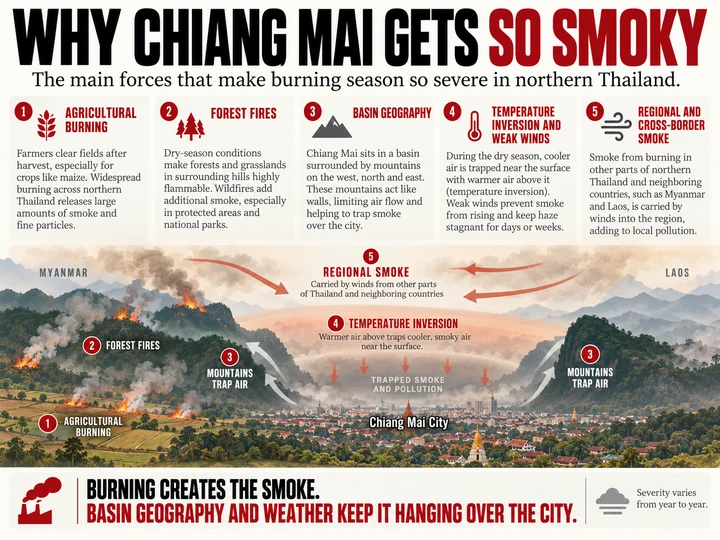
Several sources combine. Farmers across the north burn maize stubble and other crop residue after the harvest, which wraps up between about October and December, and burn again to prepare fields. Forest fires, some natural, many set deliberately to clear land or stimulate wild mushroom growth, add to the haze. Smoke also drifts in from burning in neighbouring Myanmar and Laos, and Chiang Rai, Lampang and Mae Hong Son face the same seasonal haze. Chiang Mai’s geography makes it worse: the city sits in a valley ringed by mountains, and cool-season temperature inversions trap pollution close to the ground instead of letting it disperse. A 2024 study of the March to April burning season found that agriculture accounted for roughly half of the fine particulate matter measured in Chiang Mai province. The problem is now treated as a regional emergency: in September 2025 the Thai government designated Bangkok and four northern provinces as pollution control zones, giving authorities extra powers when pollution peaks.
When the Burning Season Starts and Ends
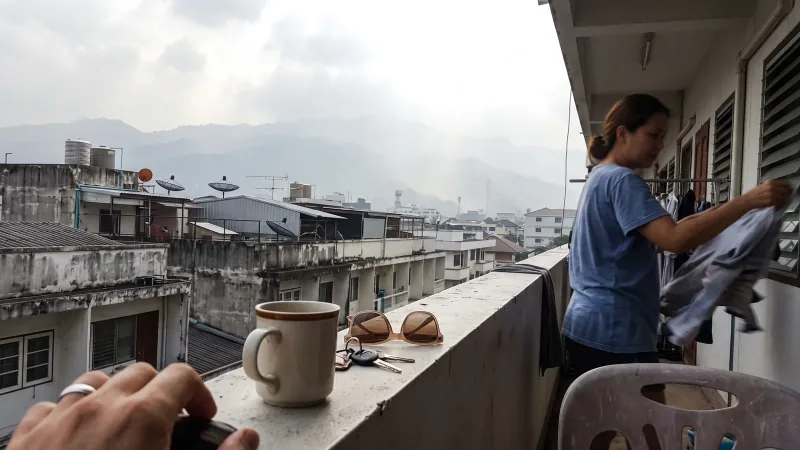
There are no fixed dates. Haze usually begins building in late January or February, peaks in March and can stay bad into April, ending only when sustained rain arrives, typically in April or May. Some years are noticeably better or worse than others, depending on how much burning takes place and how the weather behaves. Anyone planning a trip between February and April should check recent air quality reports for the specific weeks they have in mind rather than relying on a generic calendar.
Air Quality and Health Considerations
The main pollutant is PM2.5, fine particulate matter small enough to reach deep into the lungs. Thailand tightened its 24-hour PM2.5 standard to 37.5 micrograms per cubic metre in June 2023; the World Health Organization’s guideline is 15. During the worst weeks of the smoke season, Chiang Mai’s readings regularly exceed the Thai standard several times over, and the city has appeared on IQAir’s live rankings of the world’s most polluted major cities in late March and early April. In late March 2026, for example, Chiang Mai ranked as the most polluted major city in the world on that index, with AQI readings above 220 and PM2.5 concentrations near 190 micrograms per cubic metre on the worst days. On bad days the smoke stings eyes and throats even in healthy adults, and public health guidance advises sensitive groups, including children, older people and anyone with asthma or heart conditions, to limit time outdoors. Practical steps are simple: follow a live air quality index app, wear a well-fitting N95 or KN95 mask outside on bad days, keep windows closed and use an air purifier indoors. We cover the data, the causes and the policy response in more depth in our dedicated Chiang Mai air quality guide.
Should You Avoid Chiang Mai During Burning Season?
If you have respiratory problems, or your trip is built around mountain views, trekking or photography, March is best avoided and much of February and April is a gamble. If your plans are flexible and you spend your time in malls, cafes, cooking classes and other indoor spaces, a short visit is manageable, and many residents simply wear masks and carry on. But there is no way to sugarcoat it: the smoke season is the main reason the best time to visit Chiang Mai is concentrated in a shorter window than the temperature chart alone would suggest.
Rainy Season in Chiang Mai (June to October)
What the Rainy Season Is Actually Like
The Chiang Mai rainy season does not mean all-day rain. The typical pattern is a bright, humid morning followed by a heavy downpour in the afternoon or evening that lasts an hour or two, then clears. Some days bring no rain at all; occasionally a monsoon trough parks over the north and it rains for a day or two straight. Temperatures ease back from the hot season peak, with highs around 32 to 33 °C, but humidity climbs to its highest levels of the year, around 80 percent in August and September. August and September are the two wettest months, each averaging roughly 200 to 235 mm depending on the dataset, with around 17 to 21 days recording at least some rain.
Why Some Travelers Prefer the Rainy Season
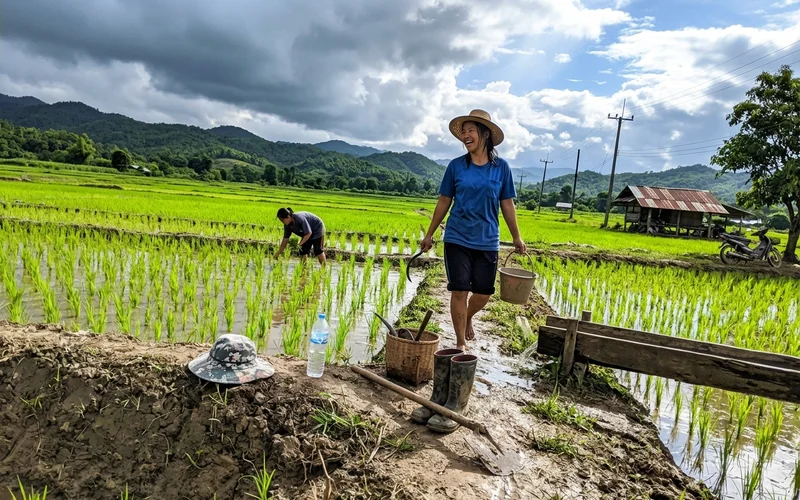
The rainy months have real advantages. The countryside turns intensely green, rice paddies fill and waterfalls run at full power, which is when they are worth the trip. The air is the cleanest of the year because the rain washes the smoke away. Tourist numbers drop sharply after June, so the old city, markets and popular temples feel relaxed, and accommodation prices fall to their annual low. Photographers get dramatic skies and lush scenery. If you plan around the rain rather than fight it, doing outdoor activities in the morning and keeping afternoons flexible, the wet season can be the most rewarding and certainly the cheapest time to visit Chiang Mai.
Flooding and Travel Disruption
Heavy years bring disruption. Low-lying areas near the Ping River can flood after prolonged rain, most often in September and October; in early October 2024 the river recorded its highest level in about 50 years and parts of the city, including areas around the Night Bazaar, were under water for days, and serious flooding also occurred in October 2022. Mountain roads occasionally close with landslides, and trekking trails turn muddy and leech-prone. Flooding on that scale is not an annual event, but if you travel in September or October it is worth keeping plans flexible and checking local news.
Chiang Mai Weather by Month
The table below shows approximate long-term climate averages for Chiang Mai city, based on Thai Meteorological Department station data. Treat the numbers as a guide to typical conditions rather than a forecast: any given year can depart from them, and the mountains run several degrees cooler than the city.
| Month | Temperature | Rainfall | Rain days | What to expect |
|---|---|---|---|---|
| January | 15–30 °C | ~10 mm | ~1 | Coolest mornings, clear skies, peak crowds ease after New Year |
| February | 16–33 °C | ~10 mm | ~2 | Flower Festival early month; first haze from mid or late February |
| March | 20–35 °C | ~30 mm | ~4 | Heat builds, smoke season at its worst late month |
| April | 23–37 °C | ~70 mm | ~6 | Hottest month; Songkran April 13 to 15; smoke lingers until rain |
| May | 24–35 °C | ~170 mm | ~15 | Still hot, humidity rises, first proper storms clear the air |
| June | 24–33 °C | ~130 mm | ~17 | Rainy season settles in, landscapes turn green |
| July | 24–32 °C | ~160 mm | ~20 | Regular afternoon downpours, low prices |
| August | 24–32 °C | ~225 mm | ~21 | One of the two wettest months; waterfalls at full flow |
| September | 23–32 °C | ~210 mm | ~18 | Heavy rain continues, highest flood risk begins |
| October | 22–32 °C | ~120 mm | ~12 | Rain eases late month; shoulder season value |
| November | 19–31 °C | ~50 mm | ~5 | Drying out and cooling down; Yi Peng and Loy Krathong |
| December | 16–29 °C | ~15 mm | ~1 | Cool nights, clear skies, busiest and priciest month |
A few patterns stand out. For most visitors deciding on the best time to visit Chiang Mai, the comfortable window for heat is November to February. The dry season for rain is effectively November to April. The overlap of the two, November to late February, is why that period is the classic answer to the best time to visit Chiang Mai, and the smoke season is why it is not longer.
The Best Month to Visit Chiang Mai
If you can only pick one month, here is how the main candidates compare.
November: The Best All-Round Month
November offers the best combination in the calendar. The rains have mostly stopped, temperatures have dropped to pleasant levels (highs around 31 °C, nights around 19 °C), the countryside is still lush from the wet season and the air is clean. Yi Peng and Loy Krathong usually fall in November, adding the year’s most atmospheric festival. Crowds build through the month but remain below the December and January peak except during the festival days themselves.
December and January: Peak Season for a Reason
December and January deliver the coolest, driest and clearest weather of the year. Nights in the city can dip below 15 °C and mornings are crisp. The trade-offs are crowds and cost: these are the busiest weeks of the year, accommodation prices peak and the Christmas to New Year stretch is packed. Book well ahead, and expect queues at the most popular temples and day trips.
February: Good Weather, Rising Smoke
February is the gamble. The weather itself is still dry and not yet excessively hot, the Flower Festival usually takes place early in the month and crowds thin after the New Year rush. But the burning season is getting underway, and by mid or late February haze often starts to dull the skies and the air quality index climbs. Some years February stays mostly clear; in others the smoke arrives early. If you choose February, go early in the month and monitor conditions.
So Which Month Is Best?
For a first visit focused on weather and scenery, late November is the strongest single pick, with December and January close behind if you book early and accept the crowds. For festivals, November (lanterns) or April (Songkran, if you tolerate heat). For value, June to October. There is no wrong answer as long as you know what each month involves, with one exception: think carefully before booking a trip centred on March.
Best Time to Visit Chiang Mai by Travel Style
Different priorities point to different months. Here is how the calendar shakes out for the most common travel styles.
Best Weather
November to February, with December and January the coolest and driest. Days average 29 to 32 °C, nights are comfortable and rain is rare. Come before late February to stay ahead of the smoke.
Fewer Crowds
The quietest months are May through September, when international arrivals drop and even the old city feels spacious. Within the high season, early November and mid-January are noticeably calmer than the Christmas to New Year peak or festival weeks.
Lowest Prices
The cheapest time to visit Chiang Mai is the rainy season, roughly June to September, when accommodation rates bottom out and deals are easy to find. Shoulder periods, May and October, also offer good value with somewhat better odds on weather. The most expensive weeks are December to early January and the Yi Peng festival period.
Festivals and Cultural Events
November for Yi Peng and Loy Krathong, early February for the Chiang Mai Flower Festival parade, April 13 to 15 for Songkran. These are fixed anchors of the Chiang Mai calendar, and each transforms the city for a few days.
Trekking and the Mountains
Trekking is best from November to February, when trails are dry, leeches are gone and views are clear. Early in the season, November to December, you also get green landscapes and wildflowers left over from the rains; late in the season the forests dry out and haze builds. Rainy-season trekking is possible but means mud, leeches and slippery paths. Note that some high-altitude nature trails, such as Kew Mae Pan on Doi Inthanon, close during the wettest months, so check ahead. Whitewater rafting on the Mae Taeng River runs the opposite calendar: it is at its best during and just after the rainy season, roughly July to November, when water levels are high.
Waterfalls
Waterfalls are at their best from September to November, full from the monsoon but accessible as the rain eases. By late in the dry season, from about February to May, many falls shrink to a trickle. Doi Inthanon National Park and the Mae Sa valley in Mae Rim district are reliable year-round options, but flow is always strongest after rain.
Photography
November to January offers the clearest skies, cleanest air and best mountain visibility. The rainy season rewards photographers with intense green rice terraces and dramatic storm clouds, especially in August and September. The Queen Sirikit Botanic Garden in Mae Rim and its canopy walkway are at their greenest late in the wet season. Yi Peng in November is the signature shot. From February to April the haze flattens light and hides the mountains.
Motorbike Trips and the Mae Hong Son Loop
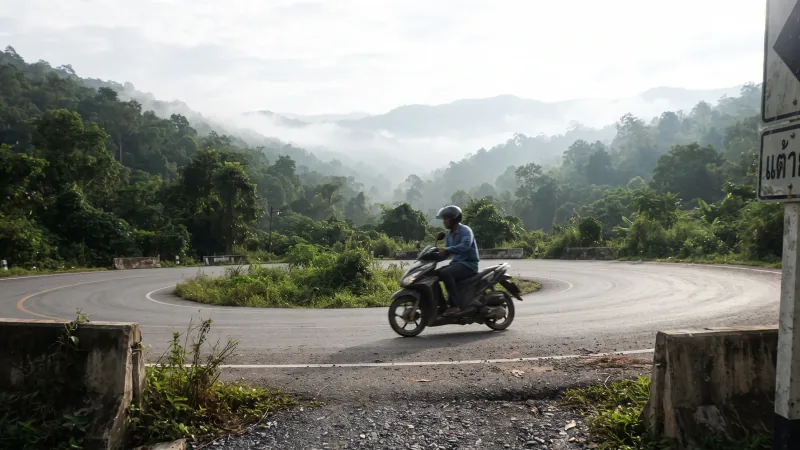
The best time to ride the Mae Hong Son Loop and other northern routes is November to February, when roads are dry, temperatures are comfortable and visibility is good. The Mexican sunflower fields at Doi Mae U Kho, toward Mae Hong Son, usually bloom around November and early December. Avoid the smoke months of March and April, when haze ruins the views that make the loop worth riding, and take extra care in the rainy season, when mountain roads can be slippery and occasionally blocked by landslides.
Families With Children
November to February is the easiest window: mild heat, little rain and everything open. Elephant sanctuaries, cooking classes and the night markets run year-round and make good rainy-day or hot-afternoon options. Songkran in April can be great fun for older children but is chaotic, very hot and hard to keep small kids dry; the December holidays are festive but busy and expensive.
Digital Nomads and Long Stays
Chiang Mai’s large digital nomad community tends to time the year around the smoke: many arrive for the cool season from November to February and leave or travel elsewhere in March and April. If you are weighing a longer stay rather than a short trip, our guide to living in Chiang Mai covers neighbourhoods, costs and the month-to-month reality of the seasons in more detail.
Festivals and Events by Season
Chiang Mai’s festival calendar concentrates in the cool season and at Songkran. Dates that follow the lunar calendar shift every year, so always confirm the current year’s programme before booking.
Yi Peng and Loy Krathong (November)
Loy Krathong is celebrated nationwide on the full moon of the twelfth Thai lunar month, usually in November, when people float decorated offerings on rivers and canals. Chiang Mai adds its own Lanna tradition, Yi Peng (also spelled Yee Peng), famous for the release of khom loi, the glowing sky lanterns that rise over the city. The combined festival runs for about three days, with parades, temple ceremonies and lanterns along the Ping River and around the old city moat. In 2026, the main nights are November 24 and 25. The festival atmosphere peaks after dark, when the lanterns rise and the river fills with krathongs. It is the most in-demand week of the year: book accommodation months ahead, and expect premium prices. Note that large organised mass lantern releases take place at venues outside the city and require tickets, while releases within built-up areas are restricted for safety and aviation reasons.

Songkran (April 13 to 15)
Songkran, the Thai New Year, has fixed national holiday dates of April 13 to 15, and Chiang Mai’s celebration is one of the biggest in the country. For several days the old city moat becomes the centre of continuous water fights, a Buddha image procession moves along Tha Phae Road and the whole city joins in. It is joyful, soaking wet and extremely hot. Book early, waterproof everything and embrace it, or avoid the city entirely that week.
Chiang Mai Flower Festival (Early February)
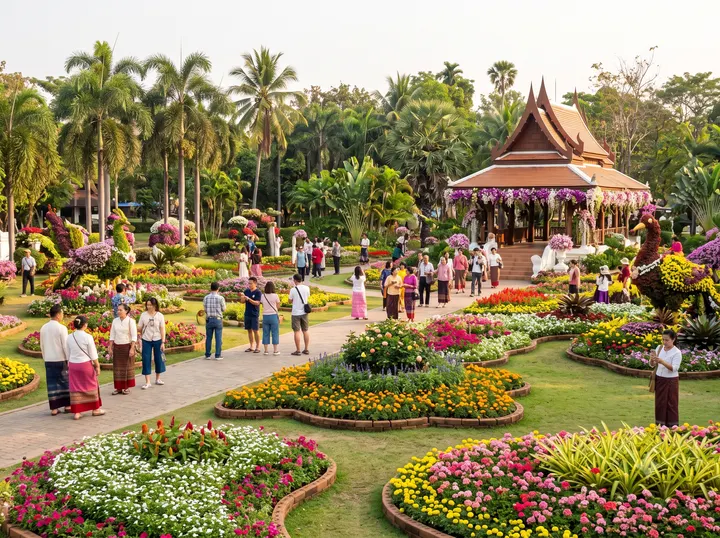
The Chiang Mai Flower Festival is usually held on the first or second weekend of February at Nong Buak Haad Public Park in the old city, with flower displays, markets and a Saturday morning parade of floral floats. The event celebrates the flowers that thrive in the north’s cool season climate, and it is one of the clearest expressions of the city’s festival culture. Recent editions ran from February 7 to 9 in 2025; dates move from year to year, so confirm before planning around it. A separate winter flower event, the Charming Chiang Mai Flower Festival, runs from December into January. February timing also means the festival sometimes coincides with the first haze of the burning season.
Other Seasonal Dates Worth Knowing
Chinese New Year falls in late January or February and is celebrated around Warorot Market in Chiang Mai’s Chinatown with lion dances and food stalls. From late December into January, wild Himalayan cherry blossom (Thai sakura) blooms at mountain sites such as Khun Chang Khian near Doi Suthep and Khun Wang on the road to Doi Inthanon. Both are worth a half-day trip if your visit lines up.
Crowds and Prices by Season
Chiang Mai’s tourism year follows the weather closely. The high season runs from November to February: visitor numbers climb from November, peak in December and January and stay strong through the Flower Festival in February. Within that window, the most crowded and expensive periods are the Yi Peng and Loy Krathong festival days, the Christmas to New Year holidays and Chinese New Year. Popular tours, ethical elephant sanctuaries and central hotels can book out weeks ahead, and accommodation prices reach their annual peak.
March and April see demand fall away as heat and smoke build, even though Songkran week itself is packed. From May through September, the rainy season low season, visitor numbers drop to their lowest levels and accommodation is at its cheapest, with wide availability even at short notice. October is a genuine shoulder month: the rains are easing, the crowds have not returned and prices sit between low and high season levels. Flexible travelers on a budget will find the best overall value in May, June, September and October.
What to Pack by Season
Cool Season Packing
Pack light layers. Days are warm enough for t-shirts, but mornings and evenings can drop below 16 °C in the city and far lower in the mountains, so bring a light jacket or fleece, one pair of long trousers and closed shoes. Sunglasses and sunscreen remain essential: the UV index stays high all year at this latitude, even in January.
Hot Season and Smoke Season Packing
From March to May, pack loose, breathable clothing, a hat, high-SPF sunscreen and a refillable water bottle, and plan days around the heat. If you are visiting between February and April, add well-fitting N95 or KN95 masks for smoky days and consider accommodation with air conditioning and, for longer stays, an air purifier. Waterproof pouches for phones and valuables are essential during Songkran in April.
Rainy Season Packing
From June to October, bring a compact umbrella and a light, quick-drying rain jacket rather than heavy waterproofs: the rain is heavy but warm and usually brief. Quick-dry clothing, sandals or shoes that tolerate wet streets and a dry bag for electronics make daily life easier. Mosquito repellent matters most in the wet months. Whatever the season, pack modest clothing that covers shoulders and knees for temple visits.
Chiang Mai City vs the Mountains
The mountains around Chiang Mai run noticeably cooler than the city, and the difference grows with altitude. As a rule of thumb, temperatures fall by roughly 5 to 6 °C for every 1,000 metres of elevation, so a 30 °C afternoon in town can be a 20 °C afternoon on a high summit.
Doi Suthep
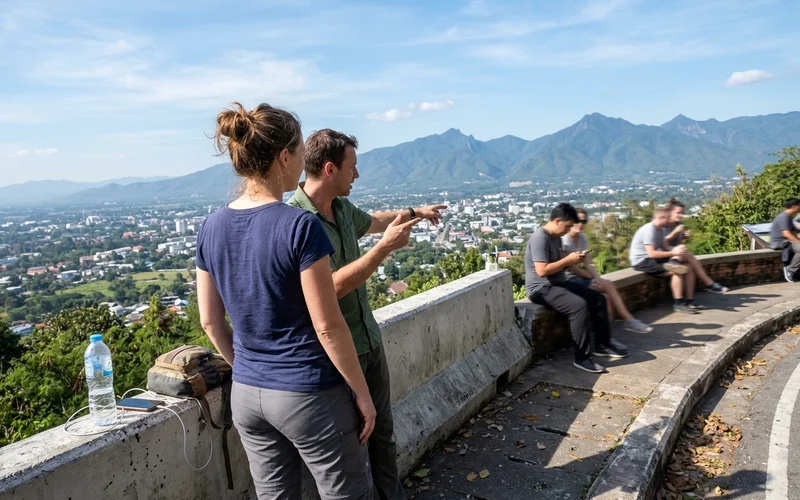
Doi Suthep rises to about 1,676 metres directly above the city, and the temple of Wat Phra That Doi Suthep sits partway up. Expect temperatures a few degrees cooler than in town, and bring a light layer in the cool season. The shady forest trail up the Monk’s Trail past Wat Pha Lat, the temple partway up the mountain, is at its most pleasant from November to January. From February to April the famous viewpoint over the city is often obscured by haze; the clearest views come from November to January and after rain in the wet season.
Doi Inthanon
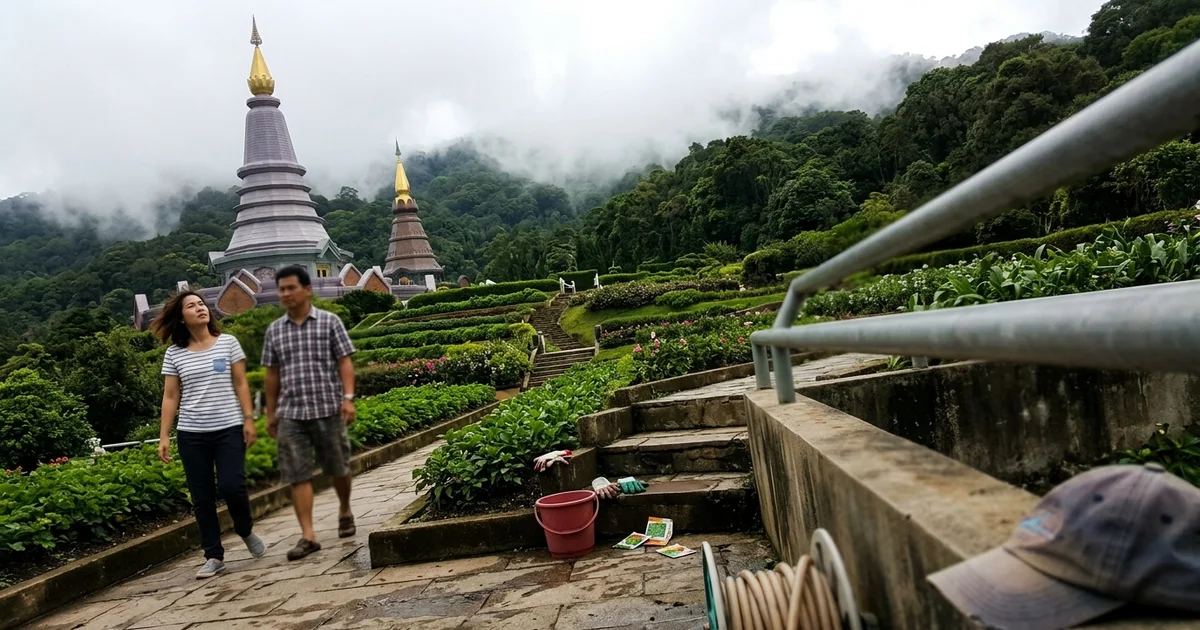
Doi Inthanon, Thailand’s highest peak at 2,565 metres, is a different climate entirely. In December and January, summit temperatures typically range from about 0 to 15 °C, with average January mornings around 6 °C, occasional drops below freezing and, in some years, frost that locals call mae khaning. Visitors arrive before dawn in January just to see it. Bring a real jacket, not just a hoodie. The mountain is a year-round destination, but trails like Kew Mae Pan close during the wettest months and cloud can hide the views in the rainy season.
When Not to Visit Chiang Mai
No month makes Chiang Mai impossible, but two periods deserve honest warnings. The first is March and the first half of April, when the smoke season peaks and the heat is at its worst; for most travelers this is the worst time to visit Chiang Mai, particularly anyone with respiratory issues or plans built around mountain scenery. The second is late September into October in years with heavy monsoon rain, when flooding can disrupt the city, as it did seriously in 2022 and 2024. Both periods are covered in more depth in our guide to the worst months to visit Chiang Mai. Outside those windows, the question is not whether to come but what you want the trip to be.
Frequently Asked Questions
Is March a good time to visit Chiang Mai?
March is usually the most challenging month. Temperatures reach around 35 °C, the smoke season peaks and air quality is at its worst of the year. Unless you have a specific reason, such as a festival or event, November to February or the rainy season are better choices.
What is the cheapest month to visit Chiang Mai?
Accommodation is generally cheapest from June to September, the heart of the rainy season low season. May and October also offer strong value. The most expensive periods are December to early January and the Yi Peng festival week in November.
Is Chiang Mai worth visiting in the rainy season?
Yes, for the right traveler. Rain usually comes in short, heavy afternoon bursts rather than all day, the countryside is at its greenest, waterfalls are full, the air is clean and prices are at their lowest. If you keep mornings for outdoor plans and afternoons flexible, the wet months can be excellent.
How bad is the burning season really?
On peak days in March, PM2.5 levels exceed Thailand’s national standard several times over and Chiang Mai has ranked among the most polluted major cities in the world on live air quality indexes. The smoke causes real discomfort and limits outdoor activity, and sensitive groups should avoid those weeks entirely. The severity varies year to year, so check recent data for your specific dates.
Is April too hot for Chiang Mai?
April is the hottest month, with average highs around 37 °C, and the smoke often lingers until the rains arrive. It is still worth considering for one reason: Songkran, from April 13 to 15, is one of Southeast Asia’s great festivals, and the city-wide water fights are a natural antidote to the heat. Go for the festival, not for comfortable sightseeing.
What is the hottest month in Chiang Mai?
April is the hottest month, with average highs around 37 °C and some days above 40 °C. March and May are nearly as hot. The coolest period is December and January, when city nights can dip below 15 °C.
What is the wettest month in Chiang Mai?
August and September are the two wettest months, each averaging roughly 200 to 235 mm of rain depending on the dataset, with some form of rain on around 17 to 21 days. September and October together carry the highest flood risk along the Ping River.
When is the best time to visit Chiang Mai for Yi Peng?
Yi Peng and Loy Krathong fall on the full moon of the twelfth Thai lunar month, usually in November. The exact dates change every year and are confirmed closer to the time, so check the current year’s dates and book accommodation several months ahead, since this is the busiest single week of the year.
Final Thoughts
The best time to visit Chiang Mai, for most people, is late November to January: cool, dry, clear and festive. Choose November for the lanterns and the last of the green season, December and January for the crispest weather, early February for the Flower Festival, April for Songkran if you can take the heat, and June to October for green landscapes and the lowest prices. Check the smoke forecast if your dates fall anywhere between February and April, and leave March to the locals.
Stay updated
Get the Chiang Mai Brief
Useful local updates, new guides, openings and practical information for living in or visiting Chiang Mai.