
Temples & Culture
Wat Chedi Luang Chiang Mai
Explore Wat Chedi Luang in Chiang Mai Old City — the ruined great chedi, Emerald Buddha history, city pillar and what to see at this Lanna monument.
8 min read
By Daniel Calleja, founder of The Chiang Mai Brief and Chiang Mai resident.
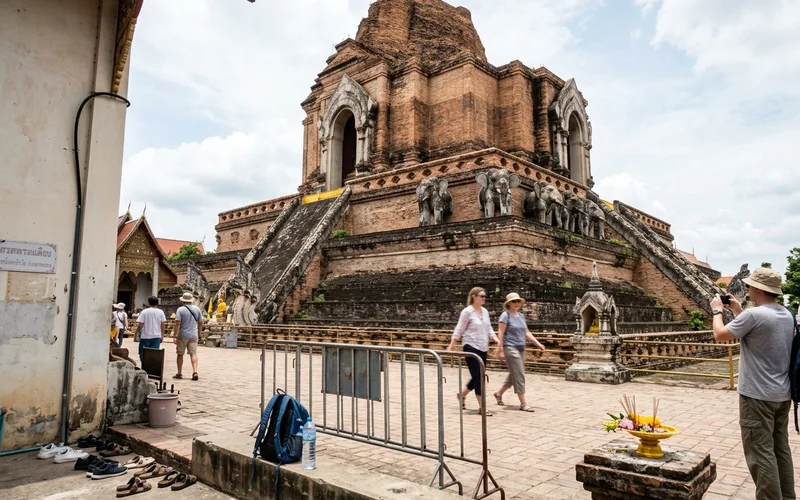
Wat Chedi Luang is a historic Buddhist temple in Chiang Mai Old City. Its best-known feature is the massive ruined chedi at its centre. The monument was one of the great religious buildings of the Lanna Kingdom and once housed the Emerald Buddha. Its broken upper section has survived centuries of change. It records Chiang Mai’s royal ambitions, sacred geography and architectural history in a direct, visible way.
Within the wider setting of Chiang Mai’s temples and culture, Wat Chedi Luang rewards more than a quick photograph. The chedi, main hall, city pillar and smaller shrines each have a different story. Together, they explain what the site means. The compound also remains an active monastery, not simply an archaeological attraction.
A royal temple at the centre of Lanna Chiang Mai
The name Wat Chedi Luang means “Temple of the Great Chedi” or “Great Stupa”. A chedi is the Thai form of a Buddhist stupa. These sacred monuments may enshrine relics or provide a focus for worship. At Wat Chedi Luang, the term refers to the enormous brick monument rising above the other buildings.
Chiang Mai was founded as the capital of Lanna in 1296. Wat Chedi Luang stands close to the centre of this historic square. The great chedi itself belongs to a later building campaign. Research based on the Chiang Mai chronicles dates the chedi to 1391. This was during the reign of King Saen Muang Ma. Chronicle tradition connects the project with a monument dedicated to his father and predecessor, Kue Na.
This was not a structure completed in one short phase. Work continued after Saen Muang Ma’s death, and the chedi was enlarged and reworked during the fifteenth century. Its development is closely linked to King Tilokaraj. His reign was a high point of Lanna power, Buddhism and art. A completion date of 1475 is often quoted. Even so, the monument should be understood as the result of several building stages, not a single design.
The Chiang Mai World Heritage programme calls Phra Chedi Luang the city’s Maha That. This marks it as a religious monument of importance to the whole city. Its central position gave architectural form to Chiang Mai’s status as the Lanna capital. The chedi was not just large. It expressed royal patronage and the close relationship between political authority and Buddhist institutions.
The rest of the compound has also changed over time. The halls, shrines and monastic buildings seen today are not all survivors from the fourteenth century. Later rebuilding and repairs have created a layered temple. Its history extends well beyond the construction of the central monument.
The great chedi: scale, form and survival
The surviving chedi is impressive because its broad mass still dominates the compound. Published accounts commonly give the completed height as about 82 metres. A 2021 architectural study led by Silpakorn University researchers produced a digital reconstruction of approximately 80 metres. These figures are best treated as close estimates, not as a precise surviving measurement. Other published figures exist, including a substantially taller estimate on the Tourism Authority of Thailand listing.
The Chiang Mai World Heritage programme calls the monument a Lanna-style Prasat-shaped chedi. In plain English, its upper form was conceived as a tiered, tower-like structure rather than a simple bell-shaped dome. The lost crown cannot now be inspected, so reconstructions of its exact appearance remain interpretations. The 2021 study compared it with other fifteenth-century Chiang Mai stupas. The closest match was the superstructure of Wat Chiang Man. That comparison is a research conclusion, not proof that the lost upper section looked exactly the same.
The same study explores possible inspiration from Ku Phaya in Bagan, especially in the treatment of internal passages. This does not make Chedi Luang a Bagan monument transplanted to Chiang Mai. The researchers argue that outside architectural ideas were adapted within a self-developed Lanna structure. Its tiered form, city-centre role and relationship to other fifteenth-century Chiang Mai stupas keep it firmly within Lanna architectural history.
Terraces, naga stairways and Buddha niches
A walk around the base reveals the chedi’s organisation. Successive terraces reduce in size as they rise, giving the monument a firmly anchored, stepped profile. Stairways project towards the cardinal directions. Their balustrades take the form of nagas, or powerful serpent beings. In Thai temple architecture, nagas act as guardians and link earthly and sacred space.
Above the stairways are recessed niches containing Buddha images. These details help break up the brick mass and give each face a devotional focus. The eastern niche has particular importance because of its association with the Emerald Buddha.
Elephant sculptures project from parts of the terrace structure. In Buddhist art across Southeast Asia, elephants can suggest strength and stability. They also express support for a sacred monument. At Wat Chedi Luang, they also help visitors read the scale of the base. Look closely, but do not assume that every sculpted detail is untouched fourteenth- or fifteenth-century work. Later conservation repaired and renewed parts of the monument.
The chedi also contains internal passages that are not ordinary visitor galleries. The Silpakorn research team used laser scanning to document these spaces and the surviving exterior. The passages had to bear heavy loads from above. The researchers suggest that this layout may have made the monument more vulnerable. This is a modern idea about the building’s structural behaviour. It does not replace the historical record of the earthquake.
Why the upper chedi is ruined
The upper superstructure collapsed during an earthquake in 1545. The broad lower portion survived, but the spire and upper tiers were lost. Popular retellings sometimes add lightning, cannon fire or different dates. The 1545 earthquake remains the best-supported explanation in historical and architectural research.
The monument did not simply remain untouched from 1545 to the present. A major conservation campaign in the 1990s stabilised and partly reconstructed the chedi. This work made the surviving structure more legible and secure, but it did not restore the complete spire. The project has also attracted criticism from heritage specialists and local commentators over the extent and character of reconstruction.
That complicated afterlife is important. Today’s silhouette is neither a complete medieval chedi nor an entirely natural ruin. It is a conserved historic structure whose missing crown still records the earthquake. The contrast between the large, ordered terraces and the irregular broken top is the building’s defining visual feature.
A full circuit reveals details that a frontal view misses. The eastern side provides the connection with the Emerald Buddha. Other faces make it easier to compare the niches, stairways and surviving upper masonry. From the rear, the relationship between the old monument and the smaller pavilions becomes clearer. No single photograph adequately explains its three-dimensional scale.
Conservation also calls for care with simple labels such as “original” and “reconstructed”. Old masonry, repaired surfaces and renewed sculptural details share the same monument. The chedi’s value lies partly in this visible record of damage, survival and changing approaches to heritage.
The Emerald Buddha and the eastern niche
Wat Chedi Luang’s connection with the Emerald Buddha adds another layer to its national importance. The image was installed in the chedi’s eastern chamber during King Tilokaraj’s reign in the fifteenth century. Published chronologies usually give the date as 1468.
The original Emerald Buddha remained associated with Wat Chedi Luang into the sixteenth century. The end of this period is commonly dated to 1551, when the image was taken to Luang Prabang. Accounts differ on the image’s movements after the 1545 earthquake. It is therefore too simple to say that it went directly from the ruined chedi to Laos.
The original image is now enshrined at Wat Phra Kaew in Bangkok. It is not still inside Wat Chedi Luang. A jade replica was placed in the restored eastern niche in 1995. It marks the earlier association and gives visitors a clear feature to find.
This history changes the meaning of the niche. It is not merely a decorative opening in the brickwork. For part of the fifteenth and sixteenth centuries, the niche held an image tied to royal legitimacy. It also carried great religious prestige across mainland Southeast Asia. Wat Chedi Luang’s role in that story is one reason the temple matters beyond Chiang Mai.
What to see around the temple compound
Start with the great chedi, but leave time for the surrounding buildings. They show how the temple still works as a religious centre. Allow time to move between the main entrance, the chedi’s different faces and the quieter structures behind it.
Main viharn and Phra Chao Attarot
The main viharn is the principal assembly and worship hall near the entrance. A viharn is a place where people gather before Buddha images, make offerings and take part in religious observance. The present hall is a much later rebuilding, not an unchanged fourteenth-century structure.
Inside stands Phra Chao Attarot, whose name refers to an eighteen-cubit Buddha. This revered standing image is generally dated to the late fourteenth century. Its height and upright posture make it quite different from the seated images that dominate many Thai temple halls. Smaller attendant images and offerings around it reinforce the hall’s role as a place of continuing devotion.
The Buddha’s raised hand can be read as a gesture of reassurance and freedom from fear. Images of important disciples and other smaller figures form part of the shrine arrangement. View these features quietly as parts of a working religious interior. They are not isolated artworks.
Compare the hall’s gables, tiered roofs and naga details with the chedi’s plainer brick mass. The two structures express different periods and materials. Together, they prevent the common mistake of treating the whole compound as one construction project.
Sao Inthakhin: Chiang Mai’s city pillar
Another important structure is the shrine for Sao Inthakhin, Chiang Mai’s city pillar or Lak Mueang. A city pillar is a sacred marker associated with the protection, identity and continuity of a settlement. Inthakhin is connected with Indra, whose name also appears in the traditions surrounding Chiang Mai’s foundation.
Local accounts say that Chao Kawila moved the pillar here in 1800. This formed part of the restoration of Chiang Mai after Burmese rule and a period of abandonment. Its presence therefore belongs to a later chapter than the great chedi. It links the temple with the city’s revival as well as its medieval Lanna past.
The tall dipterocarp trees beside the shrine form part of its traditional setting. The pillar lies beneath the shrine’s central devotional arrangement. Visitors encounter a sacred setting, not an ancient post in a museum case.
During the annual Inthakhin festival, the shrine becomes a particular focus for offerings and merit-making. Its timing follows the local religious calendar. It usually falls around May or June, not on a fixed date in the international calendar. This observance demonstrates the pillar’s civic role. It concerns the wellbeing of Chiang Mai as a community, not only individual devotion.
The shrine also has a posted traditional rule excluding women from its interior. The restriction belongs to the shrine’s specific customs rather than to the temple compound as a whole. Visitors should respect the current signs and the boundaries set by the temple.
Reclining Buddha, ordination hall and smaller shrines
Behind the great chedi are additional pavilions and Buddha images, including a reclining Buddha. In Buddhist art, this pose shows the Buddha at the end of his earthly life. He is approaching parinirvana, not simply resting or sleeping.
The compound also includes an ubosot, or ordination hall. This consecrated space is used for monastic rituals, including ordination. Its formal role differs from that of the main viharn. Smaller halls and shrines contain further Buddha images and memorials associated with the temple’s monastic community.
These quieter features help explain the site’s continuing religious life. Monks still use the monastery, and worshippers come for purposes that have little to do with tourism. Visitors share the grounds with prayer, offerings and monastic routines.
Visiting Wat Chedi Luang
Wat Chedi Luang is on Phra Pok Klao Road within Chiang Mai Old City. Around an hour is enough for a careful first visit. Allow longer if you want to study the details or spend time in the halls. Start with the main viharn. Then walk around all four sides of the chedi before continuing to the city pillar shrine and the buildings behind it.
The great chedi is best understood as an exterior monument. Its stairways and internal passages should not be treated as public climbing routes. Access to individual halls can also change during ceremonies or conservation work.
Opening hours and admission charges can change, and current published listings do not agree. Check the latest notice at the temple rather than relying on an old travel page. Monk Chat has long been associated with Wat Chedi Luang. Check directly with the temple for current availability rather than assuming a fixed daily schedule.
Dress for an active place of worship, remove shoes where required and keep noise low around worshippers. Follow posted photography rules, especially inside halls and near the city pillar shrine.
The central ruin is best read alongside the smaller details. These include the eastern niche, the standing Buddha, the city pillar and the daily routines of a working monastery. Together, they show why this is both a major Lanna monument and a living part of Chiang Mai.
Together, the chedi, halls and city pillar show why Wat Chedi Luang remains part of Chiang Mai’s temples and culture.
Stay updated
Get the Chiang Mai Brief
Useful local updates, new guides, openings and practical information for living in or visiting Chiang Mai.