Air Quality & Burning Season
Why Is Chiang Mai So Smoky: Fires, Valley Geography & Weather
Regional fires, a mountain-ringed valley and stagnant dry-season weather explain why Chiang Mai fills with smoke each year, and why the haze can sit over the city for days.
5 min read
By Daniel Calleja, founder of The Chiang Mai Brief and Chiang Mai resident.
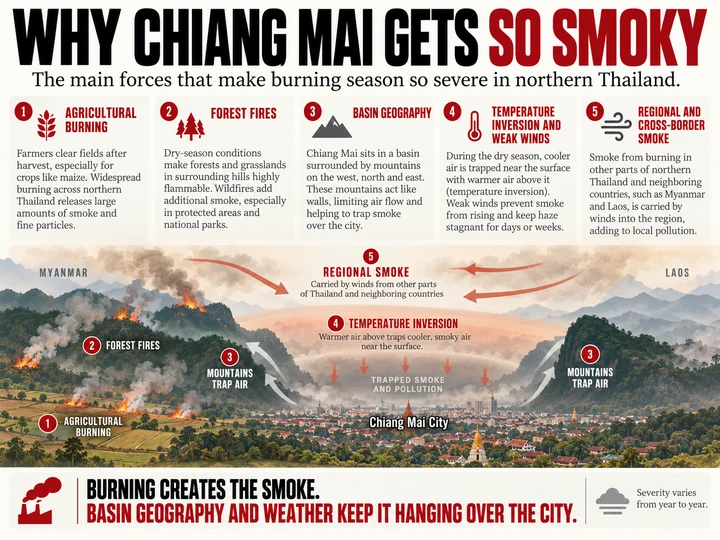
Chiang Mai is so smoky because thousands of fires burn across the region each dry season, and the valley it sits in traps what they produce. The fires are mostly agricultural burning and forest fires, many of them lit deliberately, with more smoke drifting in from Myanmar and Laos as the season builds. The smoke itself is only half the story: mountains ring the city, the air barely moves for weeks, and almost no rain falls between February and April to wash the air clean.
It starts with fire across the region
The smoke has a source, and it is not the city. By one research estimate highlighted by NASA, around 70 percent of the PM2.5 in the air over Chiang Mai in April comes from biomass burning; vehicles, power plants, industry and charcoal cooking make up most of the rest. It happens on a regional scale. Satellite sensors detected relatively few fires in January 2026, then watched them multiply through February and March; in a typical year, fire activity peaks in March before the rains return.
Three kinds of fire feed the season’s haze:
- Forest fires. Most are lit by people: Thailand’s Forest Fire Control Division attributes the clear majority of recorded forest fires to the collection of forest products such as mushrooms and bamboo, along with hunting and land clearing.
- Crop residue burning. Farmers burn stubble and field waste after harvest to clear land cheaply before the next planting, a practice the 2023 scientific review of Thailand’s air pollution identifies as a core driver of the northern haze season.
- Cross-border fires. Large areas of Myanmar and Laos burn at the same time, and the regional haze drifts across borders; in late March 2026 the ASEAN meteorological centre raised its transboundary haze alert to the highest level on its scale.
The result is that Chiang Mai’s smoke season is not really Chiang Mai’s alone. The city sits downwind of a fire zone that spans several countries, and the smoke arrives from all of them.
Why the season traps the smoke
Other cities burn things too. What makes Chiang Mai different is where it sits. The city lies in a valley basin ringed by mountains, and those mountains block the airflow that would normally carry pollution away. Through the dry season the region’s weather turns stagnant: winds drop to a near standstill, and overnight temperature inversions trap cool air near the ground under a lid of warmer air, holding smoke at valley level until late morning. Day after day the cycle repeats, and the haze can sit over the city for days at a time, because nothing arrives to flush it out.
Rain is the missing ingredient. From November to April the north gets almost none all season, so the particles that accumulate through February and March are never washed out of the air. When the first pre-monsoon storms finally arrive, usually in the weeks after Songkran in mid-April, the change is dramatic: once the rains settle in, PM2.5 in Chiang Mai falls to around 5 to 10 µg/m³.
That contrast also answers a common question. Traffic and city pollution are real, but they are minor players in the seasonal crisis. The same traffic runs all year, yet by July the air is at its cleanest of the year; in Bangkok, by contrast, vehicles are the dominant source, which is why Bangkok has nothing like the north’s spring haze. In Chiang Mai the season’s spike comes from fire, and on the worst days the AQI can sit above 150 for days at a stretch. If you are planning travel to Chiang Mai between February and April, check live air quality readings on Air4Thai before locking in dates, and on the worst days a HEPA air purifier indoors is the one measure that genuinely cuts exposure. For dates, health advice and the full seasonal picture, our Chiang Mai burning season guide covers the rest.
Frequently asked questions
Is it just farmers burning their fields?
No, and that is where the simple story fails. In the north, forest fires are the larger source, and most are started deliberately to gather mushrooms and other forest products, to hunt, or to clear land. Crop fires matter, especially in maize and rice areas, and fires across the border add a share no Thai policy can switch off. Every year the mix in the air is a little different.
Why are some years so much worse than others?
The script is fixed but the severity is not. The worst seasons line up with El Niño or neutral conditions, which lengthen the dry season and intensify fire activity, while La Niña years bring more rain: the 2022 season and the 2025 season were both noticeably mild, while 2026 pushed the AQI above 220 in late March. That is why the air quality data from one year tells you little about the next.
Sources
- NASA Earth Observatory - Smoke Shrouds Northern Thailand (23 April 2026): fire progression, the 70 percent biomass estimate, valley trapping and the ASMC transboundary alert
- Phairuang et al. (2023) - Airborne particulate matter from biomass burning in Thailand: recent issues, challenges, and options (northern causes, forest-fire ignition data, Bangkok vehicle contrast, season timing)
- NASA Earth Observatory - Hazy Skies in a Growing City (Chiang Mai PM2.5 climatology and monsoon baseline of 5 to 10 µg/m³)
- Pirard & Charoenpanwutikul (2023) - Comprehensive review of the annual haze episode in Northern Thailand (ENSO severity pattern, EarthArXiv preprint)
- IQAir Newsroom - Chiang Mai among top 10 most polluted cities in the world (27 March 2026, readings above 220)
- IQAir Newsroom - Chiang Mai among the top 10 most polluted cities during Thailand’s burning season (4 March 2026)
- Air4Thai - Thailand Pollution Control Department live air quality readings
Stay updated
Get the Chiang Mai Brief
Useful local updates, new guides, openings and practical information for living in or visiting Chiang Mai.