
Air Quality & Burning Season
Why Do Farmers Burn Crops in Northern Thailand: Crop Residue, Cost & Land Clearing
Crop residue burning clears northern Thailand's fields cheaply between harvests. What gets burned, why alternatives lose on cost and terrain, and why bans have not stopped the practice.
5 min read
By Daniel Calleja, founder of The Chiang Mai Brief and Chiang Mai resident.
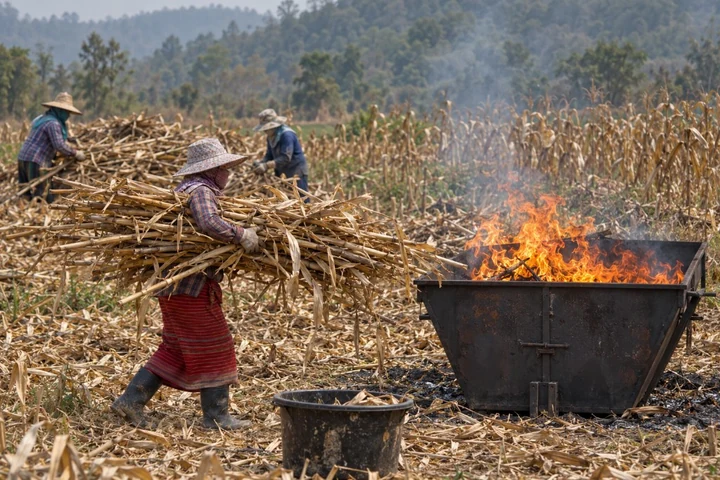
Crop residue gets burned across northern Thailand because burning is the fastest, cheapest way to clear a harvested field and ready it for the next crop. What goes up in smoke is usually not the crop itself but what the harvest leaves behind: straw, stalks, stubble, husks and leaves. Removing that material by hand or machine costs money that many small hill farms do not have, while burning clears the problem in an afternoon and costs nothing to burn. The trade-off is the seasonal air pollution that settles over cities like Chiang Mai each year.
What actually gets burned
The phrase crop burning is misleading. The valuable part, the grain or the cob, has already been harvested and sold. What remains is residue, and there is a lot of it:
- Rice straw and stubble, left standing after the harvest, in volumes that grow where irrigated fields are cropped two or three times a year.
- Maize stalks and leaves, the stover left after the cobs are picked, which upland growers gather into piles and set alight before replanting.
- Sugarcane leaves and tops, though cane burning is more common on the central and northeastern plains than in the upper north.
In the maize districts of Chiang Mai province, such as Mae Chaem, field research describes growers heaping the stalks into slash piles and burning them over a few hours to ready the plot. None of this material earns money if it stays in the field, and it physically blocks the next planting.
Why burning wins on cost, time and terrain
The decision is economic before it is anything else. Hiring labourers to cut and haul residue costs wages a small farm cannot spare, and machinery is often a dead end twice over: tractors and combine harvesters are expensive to hire, and on steep hillside plots they cannot work at all. Trucks face the same problem reaching remote fields to carry residue away. Most farmers light their fields to save money, as one village leader in Mae Chaem district in Chiang Mai province put it, and many growers are locked into annual debt cycles where even a small extra cost is unaffordable. The smoke goes straight into the air, while the alternative goes straight onto the debt.
Timing tightens the screw. Maize in the northern hills is typically harvested between October and December, and the plot must be cleared in time for replanting ahead of the rains. Irrigated rice can run two or three crops a year, leaving narrow gaps between cycles, and contract farming for the animal feed industry has pushed maize across ever more of northern Thailand’s upland fields. Fire also does several jobs at the same time: it clears weeds, destroys pests and disease carried over from the last crop, and leaves ash that returns potassium and other minerals to the soil. Set against that, Thailand’s Department of Agriculture warns that repeated burning depletes soil quality, and researchers link the practice to long-term soil degradation, so the agronomic benefit is real but heavily mortgaged.
Why the bans have not worked
Thailand issued a national zero-burning directive back in 2013, and provinces now impose blanket bans during the haze months, with occasional crackdowns: in January 2025 the government ordered every province to report how many people it had arrested for burning stubble. Yet the pollution continues, for two reasons. Enforcement is inconsistent across remote terrain, and the bans displaced rather than stopped the fires, since many growers simply burned before and after the official window and stretched the haze season at both ends. The alternatives offered so far, from hiring balers to sprays of microbial decomposer, all cost more than a match.
The response is shifting from punishment to management. Chiang Mai province now runs a permit system through an app called FireD, which uses satellite and weather data to tell growers whether the weather conditions on a given day will disperse smoke or trap it. The Department of Agriculture promotes ploughing residue in and microbial sprays that break stubble down within weeks, and the sugar industry has shown a market lever that works, with mills refusing to buy burned cane. The context matters here: agricultural burning is one part of the north’s wider air pollution problem. Estimates reported by Mongabay attribute roughly a third of Thailand’s PM2.5 to farming, rising to about half in Chiang Mai province at the March and April peak, with forest fires and cross-border smoke supplying much of the rest of the pollution. For that wider picture, our guide to Chiang Mai’s burning season explains how farm smoke combines with other biomass burning and the weather to produce the haze, and what that means for air quality at exactly the time of year when the surrounding terrain traps it.
Frequently asked questions
Do all farmers in the north burn their fields?
No. Even in Mae Chaem, the district most associated with maize residue burning, field research found the practice is not used on every plot or every farm: only the spots where residue piles accumulate are burned. Some districts have moved away from maize entirely, and cane growers cut burning sharply where mills refuse burned harvests. Agricultural burning persists where the economics leave no realistic alternative, so those who still light their fields tend to be the ones with the fewest options. Local authorities and extension services now treat access to affordable alternatives, not blame, as the way out.
Sources
- Arunrat et al. (2021) - Impact of burning on soil organic carbon of maize-upland rice system in Mae Chaem Basin of Northern Thailand (CATENA): slash-pile burning practice, timing and soil-carbon evidence
- Mongabay (2025) - Karen community fighting corn and coal for clean air in northern Thailand: debt cycles, harvest timing, farming’s share of PM2.5 (one third nationally, about half in Chiang Mai province at peak, per one 2024 study)
- Grist (2024) - Thailand’s FireD app: steep terrain and machinery costs driving burning, inconsistent enforcement, Chiang Mai’s permit approach
- Associated Press (2024) - Thailand’s 2013 zero-burning directive, displacement burning around ban windows, and the FireD permit system
- AFP via France24 (2025) - Thailand orders stubble burning crackdown as pollution spikes (January 2025 enforcement order)
- Think Global Health (2022) - The tangled problem of sugarcane burning in Thailand: rice straw volumes, multi-crop timing, low mechanisation, maize contract farming
- Phairuang et al. (2023) - Airborne particulate matter from biomass burning in Thailand (open burning as the conventional low-cost residue method on small farms)
- Winrock International / USDA #thaiRAIN - Department of Agriculture alternatives: ploughing in residue and microbial decomposers breaking stubble down in 14 days
Stay updated
Get the Chiang Mai Brief
Useful local updates, new guides, openings and practical information for living in or visiting Chiang Mai.