Air Quality & Burning Season
When Is Burning Season Worst in Chiang Mai: Peak Months & AQI
March is usually the worst stretch of burning season in Chiang Mai, from late February into early April. Why the peak lands then, how other months compare, and how to plan around the worst air.
5 min read
By Daniel Calleja, founder of The Chiang Mai Brief and Chiang Mai resident.
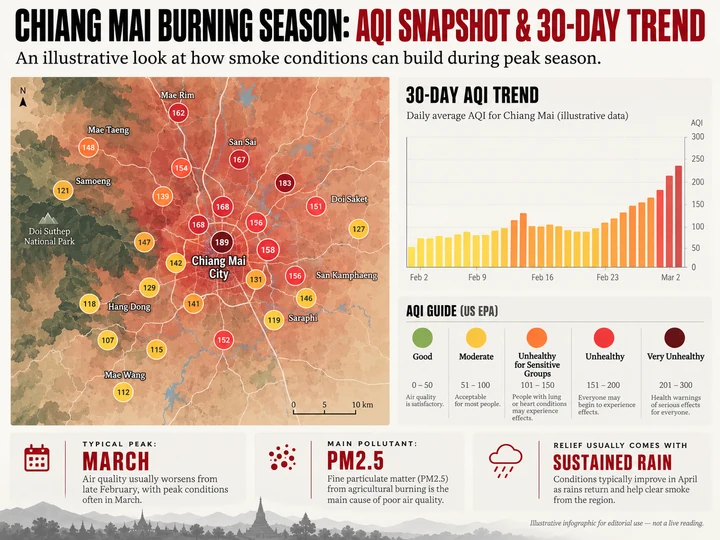
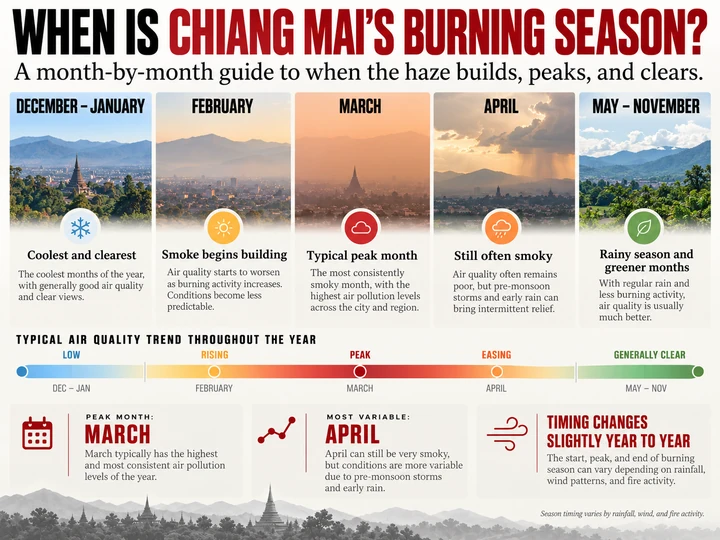
March is usually the worst month of the burning season in Chiang Mai, and the worst stretch typically runs from late February into early April. That is the window when fire activity, stagnant weather and the valley’s geography line up against you. The exact peak shifts a little between years, and conditions can flip within days, so treat any fixed date as a pattern rather than a promise.
Why March is usually the peak
Three things crest together in March. Fire activity across northern Thailand and the border regions of Myanmar and Laos typically peaks in March, according to NASA’s satellite fire records, with agricultural burning and forest fires both at their height. The weather is at its driest and stillest, and temperature inversions trap the haze in the valley, often until mid-morning. Nothing arrives to flush the valley out, because the first useful rain is still weeks away.
The air quality data backs the pattern. NASA’s PM2.5 climatology for 2017 to 2023 puts the March and April average in Chiang Mai at around 100 µg/m³, more than six times the WHO 24-hour guideline. IQAir’s annual analyses found March was the most polluted month in every year from 2017 to 2021, often by a wide margin: in 2021 the March average of 83.3 µg/m³ was nearly double February’s. On 29 March 2023 the city hit AQI 289, the worst reading on earth that day, and in late March 2026 it was again ranked the most polluted major city in the world, with readings above 220.
How February and April compare
February is the build-up, not the peak. PM2.5 roughly doubles from January as fires multiply across the region: IQAir’s 2019 records show the jump from 23.5 to 47.2 µg/m³. By mid-February the haze is a daily presence in Chiang Mai, and in some years the worst stretch arrives early. Mornings are often the most oppressive time of day, when the overnight inversion holds everything at ground level.
The tail can sting. The haze frequently outlasts March: April 2019 still averaged 74.1 µg/m³, and IQAir notes that smoke often persists until Songkran, the Thai new year festival. Relief comes with the first pre-monsoon storms, usually in the second half of the month, but that date moves. In 2026 the haze outlasted Songkran entirely, with NASA imagery showing widespread smoke over the region as late as 22 April. The end of the season is a window, not an all-clear date.
Why some years are worse than others
The season follows a script, but the severity does not. The 2023 scientific review of the air pollution episode ties the worst years in northern Thailand, including 2010, 2019 and 2023, to El Niño or neutral conditions, which prolong the dry season and supercharge fire activity across the north. La Niña years bring more rain and humidity, and 2022 and 2025 were both noticeably milder.
Timing moves with the weather. A bone-dry start to the season can pull the peak forward; an early storm can knock it back for a week. And the change can be abrupt: in early March 2026, readings in Chiang Mai went from mostly moderate to very unhealthy within days as fires flared. A mild year tells you almost nothing about the next one.
Planning around the worst air
If your travel dates are flexible, the practical move is simple: keep Chiang Mai outside the March heart of the season, or accept the risk and plan around it. For broader context, our Chiang Mai burning season guide covers causes, health advice and what to expect. If you live here, or your trip is already fixed for March, a few tips carry most of the weight:
- Check live air quality readings every morning on Air4Thai or IQAir rather than trusting the calendar; the air can change faster than the forecast.
- Plan outdoor activities for the afternoon, when the inversion lifts and readings usually dip.
- Keep N95 or KF94 masks handy for any day above AQI 150, and run a HEPA purifier in the bedroom during weeks of poor air.
- Treat sensitive groups differently: children, pregnant women and anyone with asthma or heart and lung conditions should not be here for the peak weeks at all.
Frequently asked questions
Is the worst period the same every year?
No. The pattern repeats, but the peak can shift by weeks, and severity swings widely. Thailand’s 2025 season was relatively mild; 2026 brought readings above 220 and haze that outlasted Songkran.
When does the haze finally lift?
With the first pre-monsoon storms, usually in the weeks after Songkran, followed by the established monsoon in May. Once the rains settle in, PM2.5 in Chiang Mai collapses to 5 to 10 µg/m³ and the season is over.
Sources
- NASA Earth Observatory - Smoke Shrouds Northern Thailand (23 April 2026)
- NASA Earth Observatory - Hazy Skies in a Growing City (2017–2023 PM2.5 climatology)
- IQAir Newsroom - Chiang Mai among the top 10 most polluted cities during Thailand’s burning season (4 March 2026)
- IQAir Newsroom - Chiang Mai among top 10 most polluted cities in the world (27 March 2026)
- IQAir - Thailand 2021 burning season analysis (2017–2021 monthly data)
- IQAir - Chiang Mai air quality city page (2019 monthly PM2.5 record)
- South China Morning Post - Land of Grimaces (AQI 289 and world-worst ranking, 29 March 2023)
- Comprehensive review of the annual haze episode in Northern Thailand (PMC10018570)
- Pirard & Charoenpanwutikul - Northern Thailand haze review preprint (ENSO severity pattern, EarthArXiv)
- WHO - Ambient (outdoor) air pollution fact sheet (PM2.5 guidelines)
- Air4Thai - Thailand Pollution Control Department live air quality readings
Stay updated
Get the Chiang Mai Brief
Useful local updates, new guides, openings and practical information for living in or visiting Chiang Mai.