
Air Quality & Burning Season
Should You Visit Chiang Mai During Burning Season: Is It Worth Going?
Whether a trip during burning season is worth it depends on your plans, health and the week's air quality. When going still makes sense, when to think twice, and what to do if you are already booked.
6 min read
By Daniel Calleja, founder of The Chiang Mai Brief and Chiang Mai resident.
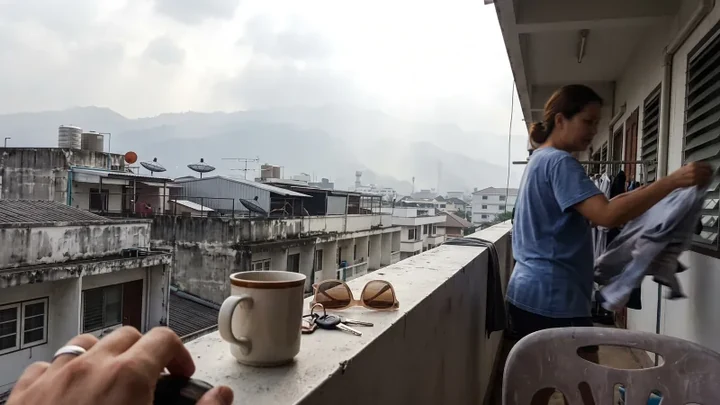
Yes, a trip to Chiang Mai can still be worth it during the burning season, but only for the right traveller, in the right week, with the right expectations. If your visit is short, your plans lean towards food, temples, cafés and markets rather than mountain scenery, and you check the air quality before committing, the city remains genuinely enjoyable. If you are coming for hiking, viewpoints and clean air, or someone in your group has asthma or another respiratory condition, the same weeks can be miserable, and changing dates is often the smarter call. Conditions swing hard between years and even between weeks, so the honest answer is a framework rather than a fixed yes or no.
What the smoke actually changes
What changes is the backdrop. The smoke is visible air pollution, not morning mist. The same fine particles that make March and April the most polluted months across northern Thailand scatter light and wash out the famous views: Doi Suthep fades behind the haze, valley viewpoints lose their ridgelines, and the US EPA notes that fine particles are the main cause of reduced visibility wherever they build up. These months are also the tail of the dry season, so afternoons run hot and rainless, and on bad days you can taste the air. Mornings are usually the worst of the day, when overnight inversions hold the haze low, and readings often ease by mid-afternoon. Hiking and cycling become genuinely unpleasant at the height of the smoky season, and outdoor sightseeing shrinks to early mornings.
What does not change is the city itself. Chiang Mai does not shut down. Temples, restaurants, cafés, markets, malls and cooking classes all operate as normal, Songkran still lands in mid-April, and visitors keep arriving through the season, though numbers dip when the haze is heavy. In 2026, after more than a month of stubborn smoke, arrivals in the mountain town of Pai, northwest of Chiang Mai, were reported down 90 percent, yet the town’s guesthouses and cafés kept operating for the visitors who still came. A trip built around food and culture loses some atmosphere but not its substance; a trip built around the mountains risks losing its main event.
When going still makes sense, and when to think twice
Going can still make sense when:
- the trip is short, roughly a week or less
- live readings look moderate in the days before you arrive
- food, temples, cafés, markets and indoor culture are the priority
- you can keep outdoor plans flexible
- clear mountain views are not the point of the trip
- your accommodation has decent filtration or a purifier
Thinking twice makes sense when:
- hiking, viewpoints or national parks are central to the plan
- PM2.5 has sat in the unhealthy bands for days running
- anyone travelling has asthma, a respiratory or heart condition, or is a young child or older adult
- hazy skies for half the trip would genuinely bother you
- your bookings are flexible enough to move
These are not arbitrary rules. March and April have averaged around 100 µg/m³ of PM2.5 in recent years, roughly twenty times the WHO annual guideline, but the spread between years is enormous: 2025 stayed relatively mild while 2026 pushed past AQI 220 and blanketed northern Thailand for weeks. Averages cannot tell you what your specific week will look like, which is why live air quality data matters more than the calendar. Visiting Chiang Mai in a mild week is a different trip from visiting Chiang Mai in a bad one. If your dates are movable, outdoor-focused trips are simply better outside the highest-smoke weeks, and if clean air is the whole point of the holiday, the southern beaches sit outside the northern haze zone entirely while other northern bases share the same smoke.
If your trip is already booked
If the flights are already paid for, the question shifts from whether to visit to how to play it. A week or two before arrival, start watching live air pollution readings on Air4Thai, the Thai Pollution Control Department’s monitoring network, or on IQAir, and check again the day before you travel. Both services show current air quality at monitoring stations across the city, and readings anywhere in northern Thailand tend to move together, so the trend matters more than any single station. Keep mountain and trekking days movable so they can slide into clearer windows, and lean into the city’s indoor life when the air is poor. Book a room with effective filtration if you can, or bring a portable HEPA purifier. Cloth and standard surgical masks do not reliably filter fine particles, while a well-fitted N95 or KF94 offers much more reliable protection. If the run-up to your dates shows severe, sustained smoke and your bookings are refundable, moving them is a legitimate decision rather than an overreaction. For the bigger picture, our overview of Chiang Mai’s Burning Season explains what drives the day-to-day swings.
Frequently asked questions
Is it safe to visit Chiang Mai during burning season?
There is no single answer, because the risk depends on concentration, duration and susceptibility. For a healthy adult on a short visit, a few days of moderate smoke is a short-term exposure problem: scratchy eyes, a cough, maybe a headache, managed by timing outdoor activity and filtering indoor air. The calculation changes for people with asthma, chronic respiratory or cardiovascular disease, children, older adults and pregnancy, the groups health agencies such as the EPA identify as most affected by particle pollution. For them, several days in the unhealthy bands carry a real risk of triggering symptoms, and different dates are the more conservative choice. Anyone visiting Chiang Mai with a respiratory condition should treat the smoke season as a genuine medical consideration and discuss it with their doctor, not as a mere inconvenience.
Can an air purifier make a hotel room safer?
Yes, measurably. A HEPA purifier running in a closed room removes the vast majority of fine particles, and EPA guidance treats portable HEPA cleaners as an effective way to cut indoor air pollution. Many hotels and rentals in the city now advertise filtered rooms or provide purifiers during the smoky months, and it is a reasonable thing to ask about before booking. A purifier does not make outdoor exposure safe on a bad day, but it gives you a clean baseline to sleep and recover in during your visit.
Sources
- NASA Earth Observatory - Smoke Shrouds Northern Thailand (23 April 2026)
- NASA Earth Observatory - Hazy Skies in a Growing City (2024)
- WHO - Ambient (Outdoor) Air Pollution Fact Sheet
- US EPA - Health and Environmental Effects of Particulate Matter
- US EPA - Air Cleaners and Air Filters in the Home
- IQAir Newsroom - Chiang Mai Air Quality Report (27 March 2026)
- Air4Thai - Thai Pollution Control Department Air Quality Network
- Pirard & Charoenpanwutikul - ENSO Influence on Northern Thailand Haze (EarthArXiv)
Stay updated
Get the Chiang Mai Brief
Useful local updates, new guides, openings and practical information for living in or visiting Chiang Mai.