Air Quality & Burning Season
When Is Chiang Mai's Burning Season?
When Chiang Mai's smoke season starts, peaks and ends — a month-by-month timeline, the historical AQI pattern and year-to-year variation.
6 min read
By Daniel Calleja, founder of The Chiang Mai Brief and Chiang Mai resident.
The short answer
February to April, peaking in March.
That’s the pattern, and it holds most years. If you want a single planning rule: assume March is bad, treat February and April as uncertain, and treat November to January as reliably clear.
For the underlying causes and the protective measures, see our burning season hub. This guide is about the calendar.
Month by month
| Month | Typical air quality | What it feels like |
|---|---|---|
| November | Excellent | Clear, cool, the best month of the year |
| December | Excellent | Cool and clear, mountain views sharp |
| January | Good | Still clear, occasional early haze late in the month |
| February | Deteriorating | First smoke appears, some bad days by month end |
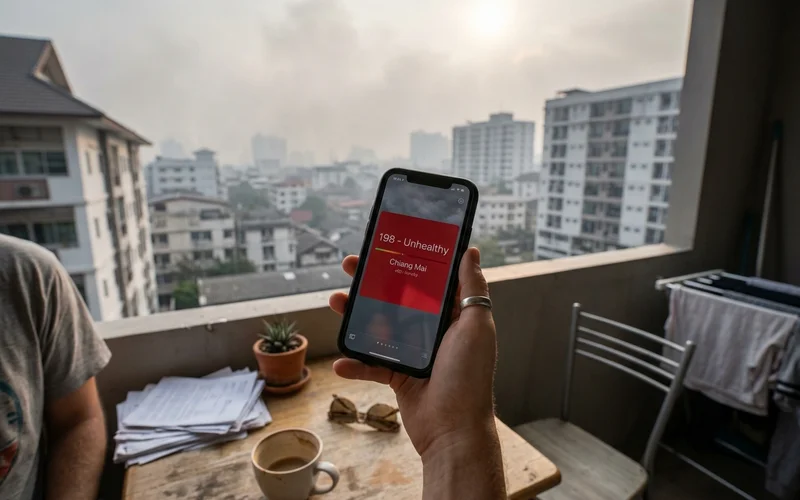
| March | Poor to very poor | The peak. Extended runs of unhealthy readings |
| April | Poor, improving | Hazy early, usually clearing after the first rains |
| May | Good | Rains established, air washed clean |
| June–October | Good | Green season. Rain keeps the air clear |
The transition into the season is gradual and the exit is abrupt. Smoke builds over weeks; the first real storm clears it in a day.
Why the dates move
Three variables shift the timing year to year:
Rainfall timing. The end of the season is essentially set by when substantial rain arrives. An early rain event in April ends it; a late one extends it into May.
Wind. Still, cool mornings trap smoke in the valley. A windier year disperses more of it.
Regional burning intensity. The smoke isn’t only local. Agricultural burning across northern Thailand, Myanmar and Laos varies with crop cycles, enforcement and economics. The reason all that smoke settles over the city rather than blowing through comes down to the valley’s shape, which we cover in why Chiang Mai’s air gets so bad.
That’s why you’ll find people who lived here for a year insisting March was fine and others describing the same month as unbearable. Both are telling the truth about different years.
The historical pattern
In peak weeks, Chiang Mai regularly appears at or near the top of global air-quality rankings, with PM2.5 readings many multiples of World Health Organization guidance. Runs of consecutive days in the unhealthy range are normal in March.
Outside that window the picture inverts completely. From May through January the city’s air is unremarkable and frequently good, which is the part that never makes the international news.
Both facts are true simultaneously, and holding both is the key to planning sensibly around it.
Planning implications
Visiting. November to February is the window. If you can only come in March, come with realistic expectations and an indoor-heavy itinerary.
Living here. Decide your March strategy in January, not in March. Whether that’s leaving, buying a purifier, or simply cancelling outdoor plans, deciding early is much cheaper than improvising.
Booking flights out. If you plan to escape, book early. A lot of Chiang Mai residents leave in the same three weeks and prices reflect it.
Long leases. Factor in that you’ll pay rent for a month you may not be here. Some people negotiate this; most absorb it.
For the wider seasonal picture — including when the festivals fall and what green season is actually like — see our guide to Chiang Mai’s seasons and when to visit.
Stay updated
Get the Chiang Mai Brief
Useful local updates, new guides, openings and practical information for living in or visiting Chiang Mai.