
Everyday Living
Chiang Mai International Schools: Fees, Curriculum & School Options
Compare Chiang Mai international schools: curricula, fees in THB, locations, admissions and boarding, plus a practical shortlisting guide for parents.
21 min read
By Daniel Calleja, founder of The Chiang Mai Brief and Chiang Mai resident.
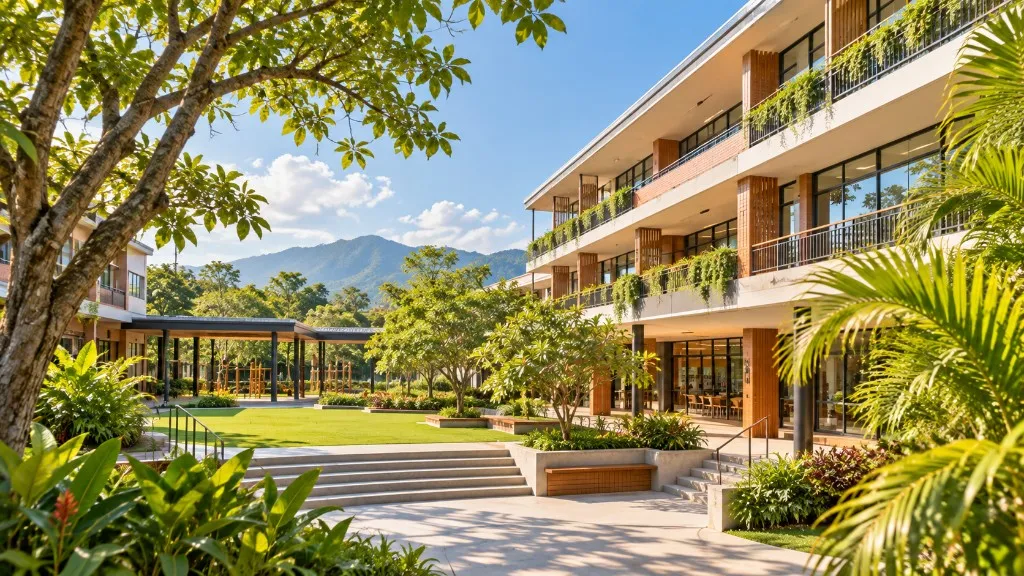
Chiang Mai has more than a dozen international school options, spread from the Old City to the northern hills and the southern suburbs. For a city of its size, the range is wide: British, American, International Baccalaureate (IB), Singaporean and European national systems are all represented, with annual tuition running from around 120,000 baht at the value end to over 800,000 THB at the top.
This page is written for parents researching Chiang Mai international schools for the first time, and for families already living here who are weighing a move between schools. It explains what separates a licensed international school from a bilingual programme, how the main curricula differ in practice, what fees look like once registration charges and extras are included, and how location should shape your decision.
Programmes, availability and fee schedules change yearly, so treat the figures here as a researched starting point for the 2026-27 academic year and confirm details with each admissions office before you commit.
Key Takeaways
- Curriculum narrows the field fast. Choosing between British, American and IB pathways usually cuts the list to two or three realistic options.
- Costs vary considerably. Annual tuition at the full-fee schools runs from roughly 200,000 baht to over 800,000 THB depending on year level, before one-time entry charges.
- Location should drive housing, not the reverse. Schools cluster to the south and north of the city plus a handful of central locations, so many families pick the school before signing a lease.
- Commute time matters more than map distance. Morning traffic on the canal road, the Superhighway and the ring roads can double a short trip.
- Admissions availability can decide for you. Popular year groups fill early at some international schools, so timing is part of the strategy.
What Counts as an International School in Chiang Mai?
The label is used loosely in this city, and the differences matter. In Thailand, a licensed international school teaches a foreign or international programme, uses English or another non-Thai language as its main language of instruction, and holds Ministry of Education recognition in that category. Most established names here also carry external accreditation, commonly from WASC, CIS, NEASC or Cambridge International.
A bilingual school is a different category. These institutions are usually licensed under the Thai private education system, follow the Thai national framework, and teach a substantial share of subjects in English. Some do this well at far lower cost, but the qualification pathway, language environment and accreditation picture differ, and families planning to move countries again should understand that before comparing prices.
Between the two sit Thai private schools with English Programme tracks, following the Thai syllabus with extra English teaching at a fraction of the price. They suit some long-term resident families, but they fall outside the accredited international category and credits may not transfer cleanly into a foreign system.
When you research, check three things: the licence category, the external accreditation, and the actual language of classroom instruction. A provider can market itself in English while delivering most teaching in Thai, and the reverse is true at some bilingual programmes with strong English streams.
Chiang Mai International Schools at a Glance
The table below compares the names parents most often shortlist among international schools in Chiang Mai. Tuition figures are approximate annual ranges from each published fee schedule for the most recent year available at the time of writing, youngest to oldest year group, and exclude the one-time entry charges covered in the fees section. Always confirm current figures with the admissions office.
| School | Curriculum / approach | Ages | General area | Approx. annual tuition (THB) |
|---|---|---|---|---|
| Chiang Mai International School (CMIS) | American, Advanced Placement | 3-18 | Wat Ket, near the city centre | 341,700-580,200 |
| Nakornpayap International School (NIS) | US-based, Advanced Placement | 3-18 | San Phi Sua, north of the city | 290,000-496,800 |
| Grace International School | American, Christian | 5-18 | Hang Dong | 309,000-379,000 |
| Unity Concord International School (UCIS) | US Common Core, Advanced Placement | 2-18 | Saraphi, Superhighway | 201,600-386,400 |
| Lanna International School Thailand | British, IGCSE and A-Levels | 2-18 | Hang Dong | 413,400-803,400 |
| Meritton British International School | Cambridge pathway, IGCSE | 2-16 | Hang Dong | 224,400-440,000 |
| Mill Hill International School Thailand | British | 2-11, expanding | Third Ring Road, toward Doi Saket | 447,300-642,600 |
| Prem Tinsulanonda International School | IB, all four programmes | 3-19 | Mae Rim | 416,000-814,000 |
| Panyaden International School | Bilingual Thai-English, IB Diploma | 2-18 | Hang Dong | 321,000-594,000 |
| American Pacific International School (APIS) | IB, with boarding | 2-18 | City primary campus, residential campus outside town | 120,300-524,800 (day) |
| Christliche Deutsche Schule (CDSC) | German, DIA Abitur | 3-18 | Saraphi | 146,000-452,000 |
| Esara International School | AMI method, integrated secondary | 1.5-16 | Hang Dong | 330,600-500,000 |
Read the table with two cautions. Tuition almost always rises with year level, so the lower figure applies to early years and the upper figure to senior years; one that looks expensive at Grade 1 may be mid-range by Grade 10. First-year costs also run materially higher once application, registration and capital charges are added, sometimes by 100,000 baht or more.
International Schools by Curriculum and Learning Approach
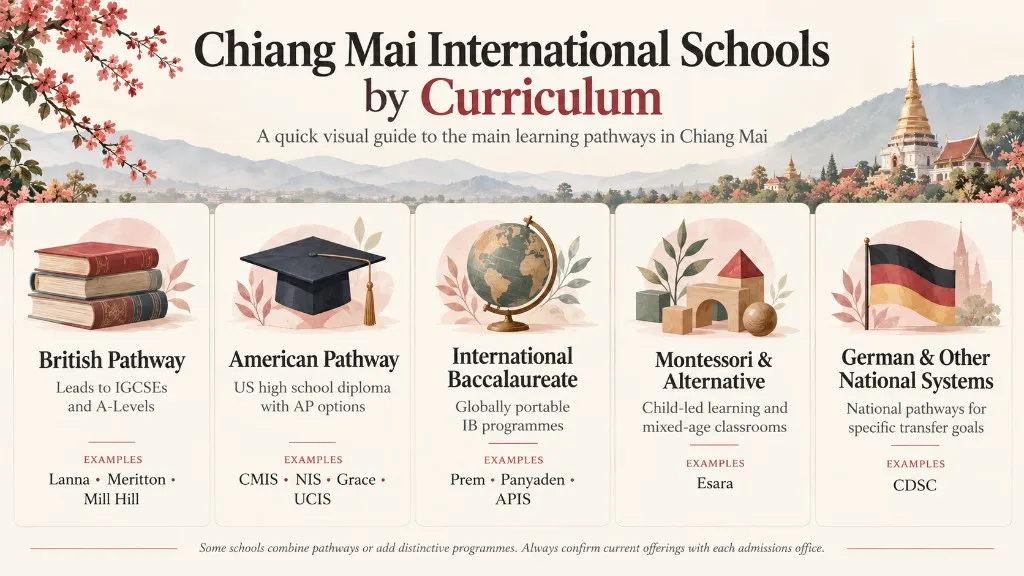
Curriculum is the most efficient filter a parent can apply, because it determines examination pathways, year-group terminology, and how easily a child can transfer when the family relocates. The city offers five main systems.
The British Pathway
This pathway follows the National Curriculum of England, leading to IGCSE examinations around age 16 and A-Levels at 18. Years run Year 1 through Year 13, roughly offset by a year from the US grade system. Lanna is the long-established example, founded in 1993 and a registered Cambridge examination centre since 2005. Meritton adds a values-based education model, and Mill Hill, opened in September 2025 as the first overseas campus of a London school group, teaches from Nursery upward with expansion toward Year 13 planned.
These qualifications transfer cleanly into the UK, Commonwealth and most university systems worldwide, and each school British families shortlist will share its IGCSE and A-Level results on request. Parents expecting a future move to Britain or Australia often find this the least disruptive pathway.
The American Pathway
The American model leads to a US high school diploma, with Advanced Placement courses in the senior years for students aiming at competitive universities. Grade terminology runs from kindergarten through Grade 12. Options include the city’s oldest international school, CMIS, founded in 1954 and accredited by WASC since 1987; NIS, founded in 1993 and accredited through 2032; Grace, faith-based and tied to the Christian missions community; and UCIS, opened in 2017 on the eastern side of the city. ACIS adds a trilingual English, Chinese and Thai emphasis.
For families moving on to the United States, or those who want AP credit recognised by universities worldwide, this pathway keeps continuity, and transfers between US-system schools abroad are usually smooth.
The International Baccalaureate
The IB is a framework rather than a national system, and Chiang Mai has one of the most complete IB offerings in Thailand. Prem was the first school in Southeast Asia authorised to offer all four IB programmes, the Primary Years, Middle Years, Diploma and Career-related Programmes, and it remains the flagship IB option in the north. Panyaden and APIS offer the IB Diploma in the senior years.
The IB suits internationally mobile parents because the framework is consistent worldwide and the Diploma is widely accepted by universities in the US, UK, Europe and Asia. It is demanding in the final two years, which is worth discussing honestly with your child.
Montessori and Alternative Approaches
A long-established Montessori option sits south of the city, now linked with Esara, covering toddlers through mid-secondary in mixed-age classrooms following AMI methods. This route suits parents who want self-directed, hands-on learning in the younger years; ask how the transition into examination-based secondary study is managed, since the approaches differ significantly. Smaller alternative providers, including an English EYFS early-years programme in Nimman, serve the preschool ages.
German and Other National Systems
CDSC, founded in 1994 in cooperation with the embassy community, is the only school of its kind in northern Thailand. Teaching is in the language of the home system, students work toward the International Abitur, and it holds the Excellent German School Abroad seal awarded by the education authorities of Germany. For those expecting to re-enter that system, the transfer problem disappears, and intensive language support exists for children arriving without it. The city also has a Singaporean-system school near the Old City and a small French programme for primary ages.
The 2026 Chiang Mai International School Education Fair brought many of the city’s international and bilingual schools together in one place, giving families a useful overview of the local education landscape.
Comparing International Schools in Chiang Mai
The profiles below cover the names parents encounter most often, based on published information from the schools and accrediting bodies. They are descriptive, not ranked.
Chiang Mai International School (CMIS)
The city’s oldest international school, founded in 1954 by the Church of Christ in Thailand community and open to all faiths. US-model programme with Advanced Placement and AP Capstone, preschool through Grade 12, on a campus near the river east of the Old City. Accredited by WASC since 1987, member of EARCOS and ISAT. Mid-to-upper cost positioning, with reduced-rate categories for eligible applicants.
Nakornpayap International School (NIS)
Founded in 1993, the oldest secular option in the city, offering a US standards-based programme with AP courses from kindergarten through Grade 12. NIS moved to a purpose-built campus in San Phi Sua, just off the Second Ring Road, and holds full WASC accreditation through 2032. Mid-range cost positioning.
Lanna International School Thailand
Founded in 1993, Lanna is the established UK option, teaching the National Curriculum of England from early years to Year 13, with Cambridge and Edexcel IGCSEs and A-Levels, from a campus in Baan Waen, south of the city. Accredited by WASC through June 2031 and currently the only one in northern Thailand holding FOBISIA membership. Upper cost positioning, though its schedule includes external examination charges that many competitors bill separately.
Prem Tinsulanonda International School
Opened in 2001 on a 100-acre campus in the hills north of the city, Prem is a full IB World School offering all four IB programmes, accredited by CIS and NEASC, with roughly 500 students from more than 30 countries. It offers both day and residential places, and its tuition sits at the top of the local market.
American Pacific International School (APIS)
Opened in 1997, APIS delivers the IB continuum with a US character, from a primary campus near the city to a main residential campus outside town. It accepts residential students from the younger grades, rare in Thailand, and day tuition spans one of the widest ranges locally, from low-cost early years to mid-range senior fees.
Panyaden International School
A bilingual Thai-English school in the southern suburbs blending the English national system, the Thai national framework and the IB Diploma Programme with Buddhist principles and a strong sustainability focus. The bamboo-built campus is widely photographed, and a “12 Wise Habits” framework shapes daily life. Mid-to-upper cost positioning, with more bundled inclusions than most.
Grace International School
A K-12 school founded in 1999 to serve the children of Christian workers abroad, on a 37-acre campus south of the city. Accredited by WASC and ACSI. Costs sit at the lower-to-mid end for a full international school, possible because overseas staff raise their own support through mission organisations.
Unity Concord International School (UCIS)
Opened in 2017 in Saraphi, along the Chiang Mai-Lampang Superhighway, UCIS offers a Common Core-based programme with AP options from the early years through Grade 12. It is among the more affordable full-programme options in the city, one reason for its rapid growth.
Meritton British International School
A smaller Cambridge-pathway option on a purpose-built southern campus, opened in the early 2020s, with a Pearson Edexcel route and Thailand’s first values-based education accreditation. It currently runs through the IGCSE years, so parents of older teenagers should confirm year-group coverage.
Mill Hill International School Thailand
The newest entrant, opened in September 2025 by the Mill Hill Education Group, a London group founded in 1807, with a local property developer. On the Third Ring Road toward Doi Saket, it opened with Nursery through Year 6 and plans phased growth to Year 13, with boarding on the longer-term roadmap. Costs sit at the premium end of the local market.
Christliche Deutsche Schule (CDSC)
The German-language option in rural Saraphi, teaching from kindergarten to Grade 12 and leading to the International Abitur. Around 300 students representing more than a dozen nationalities. Costs are comparatively moderate, with intensive language support available for non-native speakers.
Boarding Schools and Residential Options
Chiang Mai has two boarding schools in the full sense: Prem, which offers weekly and full boarding on top of tuition, and APIS, which boards from the primary years on its residential campus. Boarding charges are separate from tuition and can be substantial; at Prem, published 2026-27 charges run from 350,000 THB per year for weekly boarding to 478,000 baht for full boarding, including meals. Ask about weekend programmes, supervision and the minimum age accepted.
Choosing a School by Location and Commute
Geography here falls into three broad clusters, and where you live will start to feel like it made the choice for you if you settle before deciding.
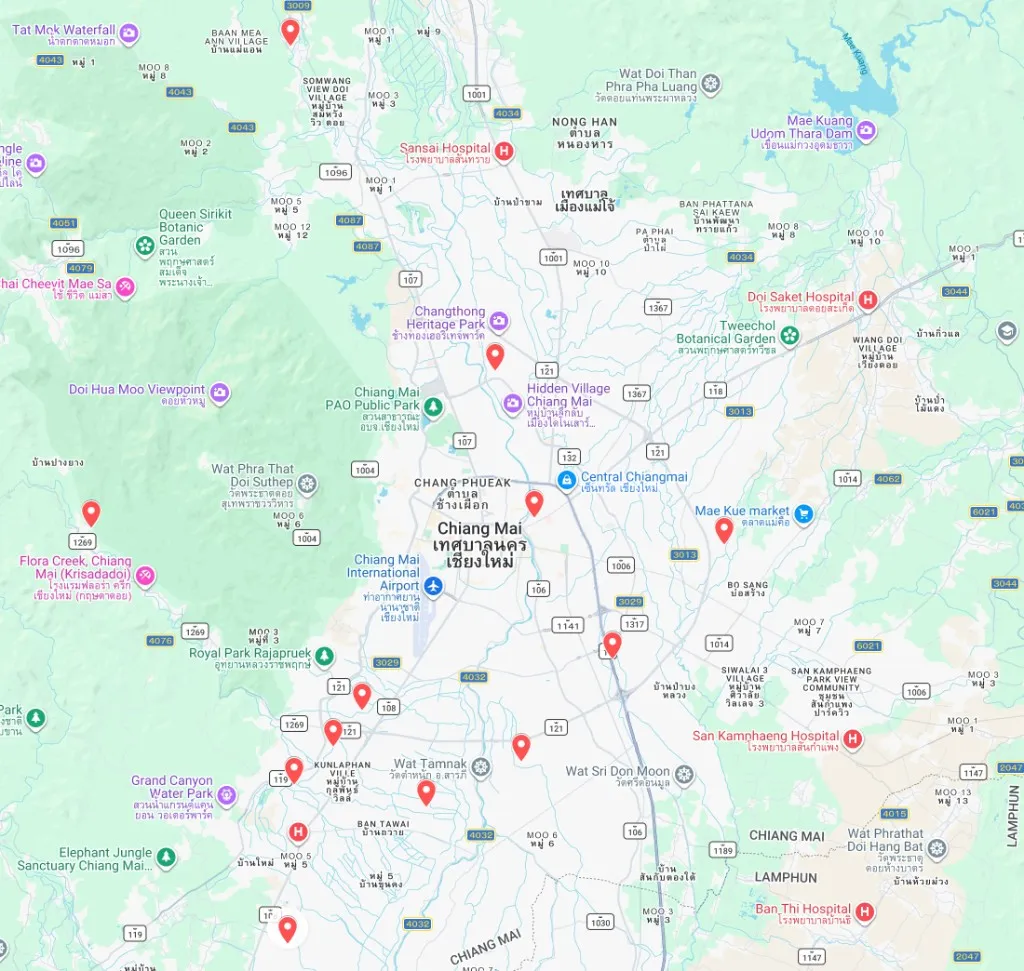
School location matters in Chiang Mai because commute times, traffic and housing choice can all shape the final decision. This map shows the relative spread of the main schools covered in this guide.
Hang Dong and the Southern Corridor
Hang Dong, the district running south and southwest of the city, holds the heaviest concentration: Lanna, Grace, Panyaden, Meritton, the Esara-linked campus and several bilingual providers all sit within its boundaries. Families living in Hang Dong, Mae Hia or the Nong Kwai corridor can often reach two or three shortlisted options without crossing the city, which is why the district is the default choice for many relocating families. The trade-off is morning traffic: routes feeding the canal road and the Outer Ring Road slow sharply at drop-off times.
Mae Rim and the North
Prem sits in Mae Rim, well north of the city on the road toward the mountains, and its catchment effectively covers the northern suburbs, the San Sai corridor and families prepared to use the bus network. The drive from central neighbourhoods is long enough that many day families structure their week around it; boarding exists partly for this reason. NIS, in San Phi Sua, is a shorter run for households along the Second Ring Road.
Central and Eastern Districts
A small number of schools sit close to the middle of town or along the eastern corridors. CMIS occupies its historic campus near the river, convenient for city-based households. East of town, UCIS and ACIS line the Superhighway corridor through Saraphi, suiting those in Tha Sala, Pa Tan or the southeastern suburbs, and CDSC occupies a rural site further into that district.
Three practical rules follow from the map. First, map distance is a poor guide to travel time here; a six-kilometre trip at 7.30 in the morning can take far longer than at midday, so drive the route at drop-off before committing. Second, bus services reduce but do not eliminate the problem; coverage and journey length vary by route, and not every housing estate is served. Third, if you are moving to Chiang Mai, choose the school before signing a long-term lease; reversing that order is a common, avoidable mistake.
International School Fees in Chiang Mai
This is the area where published numbers most often mislead, because tuition is only part of the bill. Annual tuition at full international schools in Chiang Mai currently runs from roughly 200,000 baht at the value end to just over 800,000 THB for senior years at the most expensive provider, approximately USD 6,000 to USD 24,000 depending on the exchange rate. Bilingual programmes and early-years-only options start lower.
Tuition almost always varies by year level. A single published schedule can span hundreds of thousands of baht between early years and senior years, so comparing one average figure between schools is meaningless. Compare the same year group across schools, and confirm which academic year the schedule covers, because most providers revise charges annually.
On top of tuition, budget for the standard stack of charges:
- Application or assessment charges, typically a few thousand baht, non-refundable.
- Registration, entrance or enrolment charges, one-time items that commonly run from 50,000 to 130,000 baht; CMIS, for example, lists a 100,000 THB new-student enrolment charge for secondary entrants, Lanna charges 90,000 THB at registration, and Prem lists a 130,000 THB foundation charge.
- Refundable deposits, often 15,000 to 50,000 baht, returned on departure if accounts are clear.
- Annual capital or development levies, typically 10,000 to 30,000 baht per year.
- Recurring extras: transport (roughly 30,000 to 60,000 baht a year depending on the zone), lunches, uniforms, insurance, field trips and overnight excursions.
- Examination charges at secondary level, which at some schools add tens of thousands of baht in IGCSE, A-Level, AP or IB years. Lanna is a notable local exception, bundling external examination costs into tuition.
- English-language support levies where a child needs them, which can add 40,000 baht or more per year at some schools.
Sibling discounts are common, usually 10 to 20 percent for second and subsequent children, and some providers offer payment plans or early-payment discounts. For planning purposes, a realistic first-year budget is tuition plus 20 to 30 percent.
Admissions for International Schools in Chiang Mai
There is no single admissions system; every admissions office sets its own process, so the outline below describes common practice rather than a universal rule.
Most schools follow a northern-hemisphere calendar, with the academic year starting in August, and most accept applications year-round subject to space. In practice, availability is the real constraint. Popular year groups at popular schools can fill months ahead, so families relocating for an August start should begin enquiries early in the calendar year, and those arriving mid-year should ask about the specific year group they need rather than the institution in general.
A typical application involves an enquiry and campus visit, a formal application with the associated charge, previous records and reports, identity documents for the child and parents, and then some form of assessment. Assessment varies widely: early-years children may simply attend a trial session, while older students commonly sit English and mathematics tests, and some providers interview child and parents. Year-level placement follows age cut-off dates that differ between systems, so a child moving from a UK-system to a US-system school may shift a grade; ask the admissions office to confirm placement in writing.
English-language support deserves a direct question. Most schools offer EAL or intensive English streams, sometimes at extra cost, and some assess English before offering a place. Those arriving from non-English-medium systems should ask what support exists, how long children typically stay in it, and whether it affects placement.
Two local points are worth making. Mid-year entry is generally easier here than in Bangkok, because several providers hold capacity in at least some year groups, but never assume it. And student visas are routine: schools regularly support non-immigrant ED visa documentation for enrolled children, with guardian visas for parents, though paperwork lead time means starting early matters again.
How to Shortlist International Schools in Chiang Mai
A workable shortlist process looks like this:
- Fix the pathway first. Decide which system fits your child’s history and your likely next destination; this alone removes most of the list.
- Set a realistic all-in budget. Price the correct year group using the fees section above, including entry charges, transport and extras, not just headline tuition.
- Match the school to your child’s age and needs. Check that it covers the full age range you need, including future years, and ask about learning support or English support if relevant.
- Draw the commute circle. Mark the options you could genuinely reach each morning from the areas you would consider living in, and test-drive the route at drop-off time.
- Check availability before falling in love. Ask admissions about space in the specific year group and intended start date.
- Compare facilities and programmes that matter to your child. Sport, arts, languages, boarding and university counselling differ more than marketing suggests.
- Visit or talk before committing. Book a campus tour or an extended call, ask the questions this page raises, and request the full fee schedule plus written confirmation of year placement.
Do this in order and most families end up with two or three serious candidates rather than a dozen maybes.
Frequently Asked Questions
What are the main international schools in Chiang Mai?
The names parents encounter most often are CMIS, NIS, Grace and UCIS on the American side; Lanna, Meritton and Mill Hill for the UK pathway; Prem as the full-IB day and residential option; Panyaden for a bilingual British and IB blend; APIS for IB with boarding; and CDSC for the system used in Germany.
How much do international schools in Chiang Mai cost?
Annual tuition runs from roughly 200,000 baht to just over 800,000 THB depending on the provider and year level, with most mid-range options between about 300,000 and 600,000 baht. First-year costs are higher once application, registration and capital charges are added, and extras such as transport, meals and examinations sit on top; see the fees section for the full breakdown.
Which curricula are available at international schools in Chiang Mai?
British, American, IB, Singaporean, French and other national programmes are all represented, along with bilingual Thai-English models. The UK pathway leads to IGCSEs and A-Levels, the US pathway to a high school diploma with AP options, and the IB to the Diploma Programme.
Are there British and American international schools in Chiang Mai?
Yes, several of each. The UK side includes Lanna, Meritton and Mill Hill; the American side includes CMIS, NIS, Grace, UCIS and ACIS. The differences are covered in the pathways section above.
Where are most international schools in Chiang Mai located?
The largest cluster is in Hang Dong, south of the city, with further schools in the northern hills, in and around the middle of town, and along the eastern Superhighway corridor through Saraphi. Location should influence where you live, as the commute section explains.
When should families apply to international schools in Chiang Mai?
For an August start, begin enquiries early in the same calendar year, because popular year groups can fill months ahead. Mid-year entry is often possible, but depends entirely on space in the specific year group, so ask about your child’s year level rather than the institution overall.
Do international schools in Chiang Mai offer boarding?
Two do: Prem, which offers weekly and full boarding on its northern campus, and APIS, which boards students from the primary years on its residential campus outside the city. Boarding is charged separately from tuition.
What is the best international school in Chiang Mai?
There is no official ranking, and this publication does not create one. The right answer depends on programme fit, budget, location, your child’s age and needs, and current availability, which is why this page is a comparison rather than a league table.
What are the top 5 international schools in Thailand?
Thailand has no official league table, and any fixed top five says more about the list-maker than the schools. Several Chiang Mai providers hold the same accreditations, including WASC, CIS, NEASC and IB authorisation, as the largest Bangkok institutions, which is the more meaningful comparison.
Where do American kids go to school in Thailand?
Most attend US-system schools in the major cities. In Chiang Mai that means CMIS, NIS, Grace, UCIS or ACIS for the US diploma pathway, or Prem and APIS for the IB, which US universities also recognise fully. WASC accreditation ensures transcripts transfer back into the US system.
What is the typical salary for a teacher in Chiang Mai?
Salaries vary widely by type of institution and are not published consistently, so any single figure would be false precision. Licensed international providers pay substantially more than local Thai or bilingual ones, and packages at accredited schools typically add housing, flights and tuition for dependants. Current job listings give a more reliable picture than any static number.
Stay updated
Get the Chiang Mai Brief
Useful local updates, new guides, openings and practical information for living in or visiting Chiang Mai.