Air Quality & Burning Season
What Months to Avoid Chiang Mai: Smoke, Heat & Rain
March and April are the main months to avoid in Chiang Mai, with September worth skipping for rain. Month-by-month verdicts on smoke, heat and the best windows to visit.
8 min read
By Daniel Calleja, founder of The Chiang Mai Brief and Chiang Mai resident.
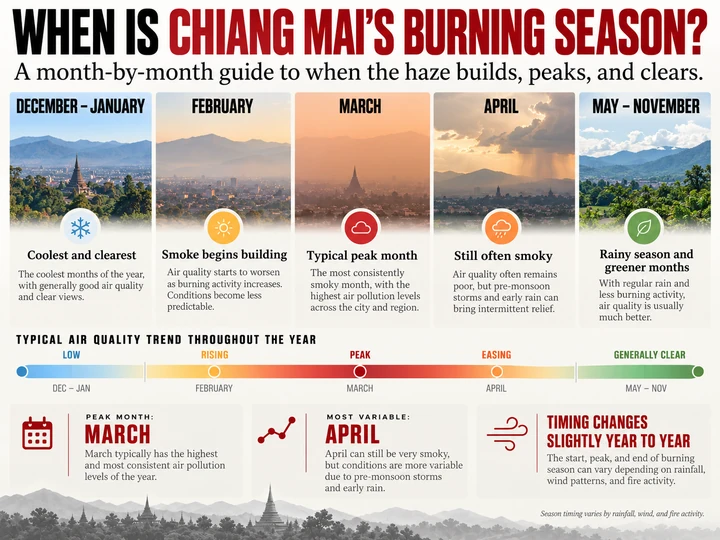
March and April are the two months most visitors should skip in Chiang Mai. Smoke from crop and forest fires across northern Thailand pools in the valley at its thickest, the air turns hazardous for weeks at a stretch, and afternoon temperatures climb toward 37°C. September is the wettest period and calls for more flexible plans, but most visitors do not need to avoid it entirely; flooding is usually limited to low-lying and riverside areas. Everything else on the calendar is workable, and most of it is genuinely good. Here is the reasoning, season by season.
Why March and April top the list
Two separate problems land in the same eight weeks. From February, farmers across the north burn crop residue and forests burn, on a larger scale still across the borders in Myanmar and Laos. Chiang Mai sits in a mountain-walled valley, so the smoke settles in and stays. Then, just as the haze peaks, the heat arrives.
March is the decisive one in Chiang Mai. It combines the worst air with the first serious heat, and even locals with somewhere else to go tend to leave. April keeps the haze until the first pre-monsoon storms break it up, usually in the second half of April, and adds the fiercest heat on top.
Travellers vote with their feet. During the severe 2023 episode, hotel occupancy in Chiang Mai and the north fell to about 45 percent when closer to 90 percent had been expected, according to the Thai Hotels Association. No other stretch of the calendar empties Chiang Mai out like this one.
The smoke: how bad it gets
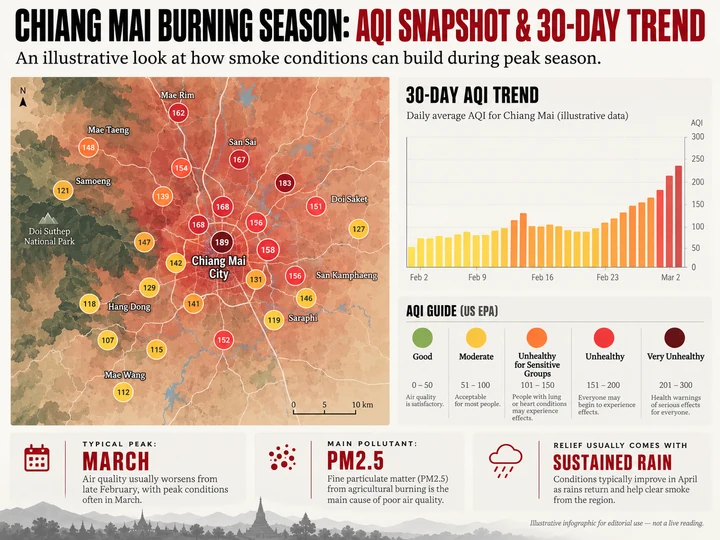
The numbers are not subtle. Across March and April, NASA satellite data shows average PM2.5 in Chiang Mai running around 100 µg/m³, roughly six times the World Health Organization’s 24-hour guideline of 15 µg/m³ and nearly three times Thailand’s own standard of 37.5 µg/m³. On 29 March 2023, Chiang Mai recorded an AQI of 289 and ranked as the most polluted city on earth that day.
On the worst days, the mountains disappear entirely. Visibility drops to a kilometre or two, eyes sting, and throats scratch within hours. Mornings are the most oppressive, because overnight inversions hold the smoke at ground level until the air warms and lifts in the afternoon.
For healthy travellers passing through, a short spell of exposure is an unpleasant memory. For young children, pregnant women, older travellers and anyone with asthma or heart or lung conditions, March and early April in Chiang Mai carry real risk. For the full picture of what drives the smoke, our burning season guide has the detail.
The heat that comes with it
April is the hottest month in Chiang Mai, and it is not close. Long-term records put average afternoon highs at 35 to 37°C, with nights around 24°C and an all-time record of 43.6°C. March runs only a degree or two cooler. This is the hot season at full force: a midday temple tour becomes an endurance test.
The one redemption is Songkran, the Thai New Year water festival from 13 to 15 April, when Chiang Mai turns into a water fight and the heat becomes half the fun. If you are coming for Songkran specifically, April is worth it. If you are not, there is no reason to be here.
What about the rainy season?
The rainy season runs from May to October, and it is far better than its reputation. The classic pattern is a bright morning, an hour or two of heavy rain in the afternoon or evening, then clearing skies. Locals call these the green months: waterfalls at full power, rice paddies vivid, dust washed out of the air.
The trade-offs are real but manageable. Humidity climbs, some rural roads turn to mud, and a trekking itinerary can lose an afternoon to a downpour. What the rain almost never does in Chiang Mai is fall all day. Most days still deliver several usable hours of sunshine, and hotel prices in Chiang Mai drop to their lowest of the year. For budget travellers and anyone who dislikes crowds, June and July are underrated.
September and October: the wettest stretch
The rain peaks late. Station records put August and September as the wettest months in Chiang Mai, with rainfall of 220 to 240 mm in a typical year, several times what May or October receive. September is the one to treat with respect: downpours run longer and harder, and low-lying areas near the Ping River can flood.
Most years that means impassable lanes and soggy shoes rather than danger. But not every year. In late September and early October 2024, the Ping reached its highest level in 50 years, riverside neighbourhoods went under, train services stopped, and thousands of residents were evacuated. Events like that are the exception rather than the rule, so September is better treated as a month for flexible plans rather than one most visitors need to avoid.
October is the turnaround. The rain tapers, the countryside glows, prices stay low, and the weather settles as the weeks pass. Late October is one of the best-value windows going.
When Chiang Mai is at its best
November to February is the cool season in Chiang Mai, the dry season in all but name, and it earns its reputation. Daytime highs sit around 26 to 30°C, nights in December and January drop to a crisp 12 to 15°C, skies are at their clearest, and the dry air makes walking the Old City a pleasure. It brings the most comfortable weather all year for trekking, cycling and every other outdoor activity.
It is also when Chiang Mai’s calendar fills up. Yi Peng and Loy Krathong, the lantern festival and its river-bound twin, fall in November (24–25 November 2026, 14–15 November 2027), and the Flower Festival takes over on the first weekend of February.
The trade-off is price and people. This is peak season, and flights and hotels cost accordingly, with the festival week booking out furthest ahead. Early November and February run noticeably quieter than the December and January peak.
If March or April is your only window
Sometimes the dates are fixed. If you must travel then, a few adjustments take the edge off:
- Check the AQI each morning on Air4Thai or IQAir, and save outdoor activities for the afternoon, when the haze lifts.
- Pack well-fitting N95 or KF94 masks for any day above AQI 150, and keep children indoors when readings spike.
- Book a hotel with good seals and a pool, and line up indoor backups: museums, cooking classes, cafés, cinemas and malls.
- Create one clean-air room. Run a HEPA purifier in the bedroom with the windows closed; it cuts indoor PM2.5 sharply even when outdoor readings are hazardous.
None of this makes March pleasant. It makes it survivable and, the Songkran week aside, you will have Chiang Mai largely to yourself.
The verdict at a glance
| When | Conditions | Verdict |
|---|---|---|
| January | Cool, dry, clear; busiest | Go |
| February | Warm, dry; smoke builds late | Go early |
| March | Worst smoke; 35°C afternoons | Avoid |
| April | Hottest; haze until the storms break | Avoid |
| May | First storms flush the air clean | Workable |
| June | Afternoon downpours; green and quiet | Good value |
| July | Regular rain; lowest prices | Good value |
| August | Heavy rain sets in | Keep plans loose |
| September | Peak rain; localized flood risk | Keep plans flexible |
| October | Rain easing; lush and empty | Best late value |
| November | Cool season begins; Yi Peng week | Best overall |
| December | Crisp, clear, crowded | Go, booked ahead |
Frequently asked questions
What is the best month to visit Chiang Mai?
For most people visiting Chiang Mai for the first time, November is the answer. The cool season weather has arrived, the smoke is still months away, and Yi Peng and Loy Krathong light up the same week. December and January are just as comfortable, only busier and pricier.
Is Chiang Mai worth visiting in the wettest months?
For the right traveller, yes. Rain falls in bursts rather than all day, prices hit their floor, and the scenery is at its greenest. Keep one or two indoor activities in reserve and you will lose very little. September is the wettest stretch, and localized flooding can affect low-lying and riverside areas, but most visitors travel successfully with flexible plans. It is not equivalent to March and April for smoke and heat.
Does the smoke affect all of northern Thailand?
It does. Chiang Rai, Mae Hong Son, Lampang and Nan share the same regional haze, so moving within the north does not escape it. If a March or April trip to Thailand is fixed, the coasts are the cleaner alternative while the north waits for the rain.
Sources
- Thai Meteorological Department — climate and seasonal monsoon information: Source
- ERA5 climate record for Chiang Mai, monthly temperatures and rainfall 1940–present: Source
- NASA Earth Observatory — Hazy Skies in a Growing City, PM2.5 climatology 2017–2023: Source
- IQAir — Chiang Mai air quality records: Source
- World Health Organization — Ambient (outdoor) air quality and health: Source
- Reuters — Pollution choking Thailand’s north hits tourism, 10 April 2023: Source
- Al Jazeera — At least three killed as floods swamp Thailand’s Chiang Mai, 7 October 2024: Source
- Thailand Highlights — Yi Peng and Loy Krathong festival dates 2024–2028: Source
- Lonely Planet — The best time to visit Chiang Mai: Source
- Air4Thai, Pollution Control Department — live AQI for Thai monitoring stations: Source
- US Environmental Protection Agency — patient exposure and high particle pollution events (portable air cleaners reduce indoor PM2.5): Source
Stay updated
Get the Chiang Mai Brief
Useful local updates, new guides, openings and practical information for living in or visiting Chiang Mai.