
Visas & Immigration
DTV vs Retirement vs Education Visa: Which Fits You
Compare the main long-stay visa routes for Chiang Mai — DTV, retirement and education — by eligibility, cost, duration and who each suits.
7 min read
By Daniel Calleja, founder of The Chiang Mai Brief and Chiang Mai resident.

Three routes, three different lives
Almost everyone planning long-term living in Chiang Mai is on one of three visas. They serve genuinely different situations, and the most common mistake is choosing based on what a friend did rather than on your own age, income source and appetite for admin.
This guide sets them side by side. For the detail on each, see our visa guide and the individual pages on the DTV in detail and the retirement visa.

The comparison
| DTV | Retirement (Non-O / OA) | Education (ED) | |
|---|---|---|---|
| Minimum age | 20 | 50 | None |
| Core requirement | Foreign income + ~500,000 THB savings | 800,000 THB banked or 65,000 THB/month | Enrolment in an approved course |
| Validity | 5 years, multiple entry | 1 year, renewable annually | Typically 1 year, renewable |
| Stay per entry | 180 days, extendable once | Continuous, with annual extension | Continuous, with periodic extension |
| Apply from | Outside Thailand | Abroad or converted in-country | Abroad or converted in-country |
| Ongoing cost | Low | Low fees, capital tied up | Tuition, ongoing |
| Work permitted | No Thai employment | No | No |
| Reporting | 90-day + TM30 | 90-day + TM30 + annual extension | 90-day + TM30 + attendance |
Who each one actually suits
The DTV suits remote workers, freelancers and contractors under 50 with income from outside Thailand, plus people coming for extended Muay Thai training, cookery courses or medical treatment. If you can evidence foreign income and hold the savings threshold, it is almost always the best value option — five years of coverage with no annual renewal grind.
The retirement visa suits anyone 50 or over with either the capital to park 800,000 THB in a Thai account or a verifiable pension of 65,000 THB a month. It’s the most established route, the immigration process is routine, and Chiang Mai’s office handles enormous volumes of it. The downside is the annual cycle and the tied-up capital.
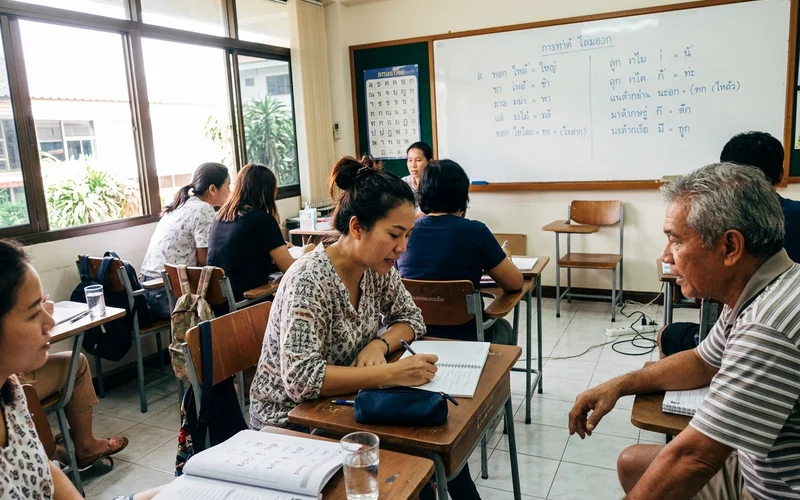
The education visa suits people who genuinely want to study — Thai language, Muay Thai, or a formal course. It has a legitimate place, particularly for people under 50 who don’t have documentable foreign income. It also involves real obligations: attendance requirements, tuition, and course providers of very variable quality.
The trade-offs people underestimate
Capital versus cash. The retirement visa’s 800,000 THB isn’t spent, but it is unavailable. For someone whose wealth is in a pension or property, finding that liquidity is the actual barrier — not the visa process.
Documentation versus flexibility. The DTV asks you to prove a working relationship with foreign entities. If your income is informal, irregular or paid in cash, that proof is harder to assemble than the savings threshold.
Course obligations. Education visas have tightened. Attendance is checked, and a school that treats enrolment as a paperwork exercise is a school that may cause you problems later. If you take this route, pick a provider with a real teaching record.
Reporting is universal. All three routes carry 90-day reporting and TM30 obligations. Nobody escapes the quarterly admin.
A quick decision path
Work through these in order:
- Are you 50 or over with 800,000 THB available or a 65,000 THB monthly pension? The retirement visa is probably your route.
- Do you work remotely for foreign employers or clients, with documentation? The DTV, almost certainly.
- Neither, but you genuinely want to study Thai or train seriously? The education visa.
- None of the above fit cleanly? Look at the Long-Term Resident visa if you’re a high earner, or consider whether a shorter stay on a visa exemption makes more sense while you sort your position out.
Whichever you choose, the local mechanics are identical, and getting comfortable with them early makes the whole thing far less daunting than it looks from the outside.
Stay updated
Get the Chiang Mai Brief
Useful local updates, new guides, openings and practical information for living in or visiting Chiang Mai.